
📖 12 min read · 2,389 words
The Karthika Pournami date in 2026 falls on Tuesday, 24 November, which sits almost three weeks later than the day observed in 2025. That jump is not a printing error. A leap month in the Hindu lunar calendar pushed the whole festival cycle forward. Several widely-read websites still show an outdated November figure for this year.
This guide pins down the Karthika Pournami date with a verified tithi window. It also explains why the day moved, lists checked dates from 2022 to 2027, and covers the regional differences that trip up readers. It also keeps the original 2022 details, because plenty of people still search for what happened that year.
Prayanamam is an independent pilgrimage guide. We are not affiliated with any temple, trust, or shrine board, and we do not take bookings, donations, or payments. For darshan tickets, seva slots, or official announcements, use the temple’s own portal.
Karthika Pournami Date 2026 at a Glance
Here is the short version, if you only need the Karthika Pournami date and its timings before moving on.
- Observance day: Tuesday, 24 November 2026.
- Purnima tithi begins: 11:42 PM on 23 November 2026 (IST, New Delhi reference).
- Purnima tithi ends: 08:23 PM on 24 November 2026 (IST, New Delhi reference).
- Also marked as: Kartik Purnima, Tripuri Purnima, Dev Deepawali and Guru Nanak Jayanti.
- Unusual in 2026: Tamil Karthigai Deepam lands on the same day, although the two festivals follow different calendars.
- Why it shifted: Adhika Jyeshtha Masam ran from 17 May to 15 June 2026, so every later festival moved forward.
Karthika Pournami Date and Tithi Timings for 2026
Devotees observe the day on 24 November 2026 because the purnima tithi covers sunrise on that date. The tithi opens late on the night of 23 November and closes in the evening of 24 November. Panchang reckoning starts a day at sunrise, so the full moon night belongs to the 24th.
| Event | Date and time (IST) |
|---|---|
| Karthika Pournami observance | Tuesday, 24 November 2026 |
| Purnima tithi begins | 11:42 PM, 23 November 2026 |
| Purnima tithi ends | 08:23 PM, 24 November 2026 |
| Deep daan (evening lamp offering) | Pradosh window after sunset, 24 November 2026 |
These figures follow the New Delhi reference used by mainstream panchangam publishers such as Drik Panchang. Sunrise, sunset and moonrise shift by several minutes across India. A family in Visakhapatnam will see a slightly different clock than one in Ahmedabad. The tithi start and end times, however, stay the same nationwide.
Why the Karthika Pournami Date Moved Almost Three Weeks
Hindu lunar years run roughly 354 days, while the solar year runs 365. Festival dates therefore drift about eleven days earlier each year, until the gap grows to a full month. At that point the calendar inserts an extra month called Adhika Masam, and everything after it snaps forward by around nineteen days.
That correction happened in 2026. Adhika Jyeshtha Masam ran from 17 May to 15 June 2026. Festivals from June onward therefore landed far later than a simple year-on-year guess suggests. Kartik Purnima fell on 5 November in 2025, yet in 2026 it lands on 24 November.
This is exactly where several sites went wrong. More than one popular astrology and festival portal still lists 5 November 2026. They carried last year’s figure forward without recomputing it. If a page shows you an early-November date for this year, treat it as stale and check a panchangam directly.
Karthika Pournami Date List From 2022 to 2027
Readers often arrive here looking for a different year, so here is the verified run. Each row was confirmed against panchang sources rather than calculated from a single anchor year.
| Year | Observance day | Notes |
|---|---|---|
| 2022 | Tuesday, 8 November | Total lunar eclipse the same day |
| 2023 | Monday, 27 November | Dev Deepawali marked on 26 November |
| 2024 | Friday, 15 November | Standard observance |
| 2025 | Wednesday, 5 November | Standard observance |
| 2026 | Tuesday, 24 November | Shifted late after Adhika Masam |
| 2027 | Sunday, 14 November | Returns to the usual window |
Notice how the Karthika Pournami date in 2023 and 2026 both break the pattern. In both years the tithi straddled two calendar days, so snan-daan and the evening lamp ritual did not always fall together. That single detail explains most of the confusion readers report.
What Happened on the 2022 Full Moon
The Karthika Pournami date in 2022 fell on Tuesday, 8 November. The purnima tithi began at 04:15 PM on 7 November and ended at 04:31 PM on 8 November. Most guides stop there, yet the year carried an unusual complication.
A total lunar eclipse occurred on 8 November 2022, and it was visible from eastern Indian cities. Because a grahan makes evening lamp offerings inauspicious, the Central Dev Deepawali Committee in Varanasi moved the celebration to Monday, 7 November 2022. Pilgrims who travelled for the 8th missed the illuminated ghats entirely.
That episode is worth remembering. Eclipse timing can override the printed festival date at specific sites, so a local temple announcement always outranks a generic calendar.
Karthika Pournami and Karthigai Deepam Are Not the Same Festival
These two names get mixed up constantly, so people book travel around the wrong Karthika Pournami date and waste a trip. Karthika Pournami follows the lunar calendar and falls on the full moon of Kartika masam. Karthigai Deepam follows the Tamil solar calendar and falls when Krittika nakshatra prevails in the month of Karthigai.
Because the two systems run independently, the dates usually differ by several weeks. In 2025, for instance, Kartik Purnima came on 5 November while Karthigai Deepam came on 3 December. In 2026 the two happen to coincide on 24 November, when the Maha Deepam is lit atop Arunachala hill at Tiruvannamalai.
That overlap makes 2026 an unusually heavy day at Tiruvannamalai. Girivalam crowds and Deepam crowds arrive together. If you plan that circuit, read our Tiruvannamalai Karthika Pournami timings guide before booking travel. The Ministry of Tourism also lists the Maha Deepam festival schedule on its Utsav portal.
Why Devotees Mark This Full Moon
Kartika masam carries a reputation as the holiest lunar month, and its full moon closes the month with the heaviest observance. Several traditions converge on the same night:
- Tripuri Purnima: devotees remember Shiva’s victory over the demon Tripurasura, which gives the day its alternate name.
- Matsya avatar: some Vaishnava traditions hold that Vishnu appeared as the fish incarnation on this tithi.
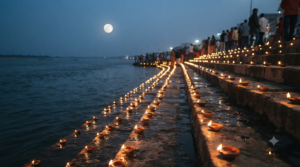
- Dev Deepawali: Varanasi lights lakhs of lamps along the ghats, since the gods are said to descend to the Ganga.
- Guru Nanak Jayanti: Sikhs mark the birth anniversary of Guru Nanak Dev Ji on Kartik Purnima, which in 2026 means 24 November.
- Bhishma Panchaka: the five-day Vaishnava fast that starts on Prabodhini Ekadashi concludes on this day.
These beliefs belong to tradition and devotional literature rather than to verified history. Read more background on the Kartika Purnima entry if you want the wider religious context.
Pooja Vidhi: How Families Observe the Day
Most households follow a familiar sequence, although regional practice varies. Nothing here needs a priest or a temple queue, so a home observance works perfectly well.
- Kartik snan before sunrise. Devotees bathe in a river or add a little holy water to a bucket at home while chanting.
- Lamp lighting. Families light ghee or sesame oil lamps at the tulsi plant, the doorway and the puja space.
- Worship of Shiva and Vishnu. This is the one full moon dedicated to both, so many homes keep both images on the altar.
- Reading or chanting. Households recite the Vishnu Sahasranama, the Bhagavad Gita, or Shiva stotras through the morning.
- Daan. Food, warm clothing, rice or lamps go to those in need, since charity carries special weight during Kartika masam.
- Arghya to Chandra. After moonrise, devotees offer water to the moon and complete the fast if they kept one.
An Hour-by-Hour Plan for 24 November 2026
A rough timeline helps if you are observing the day for the first time. Adjust the clock to your city’s sunrise, because the sequence matters more than the exact minute.
- Before sunrise: take the Kartik snan and complete the morning sankalpa.
- Morning: perform the main puja and light the first lamps while the tithi still runs.
- Midday: distribute daan, or serve a meal if you plan annadaan.
- After sunset: light the deep daan lamps during the pradosh window.
- 08:23 PM: the purnima tithi ends, so finish arghya and any vrat sankalpa before this point.
Where Crowds Gather, and What to Do If You Cannot Travel
Varanasi draws the largest gathering, with lamps lining all 84 ghats from Ravidas Ghat to Rajghat. Pushkar in Rajasthan holds its cattle fair and mela around the same tithi, while Tiruvannamalai draws lakhs for girivalam and the Deepam. Odisha marks Boita Bandana, when children float miniature boats in memory of ancient maritime trade.
None of this is guaranteed to go smoothly, and honest planning matters more than optimism. Ghat-side hotels in Varanasi sell out months ahead. Boat access narrows on the night itself, and police close several approach roads to vehicles. Tiruvannamalai routinely restricts the girivalam path to pedestrians for a full day around the Deepam.
If travel falls through, the observance does not. Light lamps at home and give daan, which every tradition treats as equally valid. If a river visit is impossible, add a small quantity of stored holy water to your bath. If accommodation is gone, most pilgrims shift to a nearby town and travel in on the morning itself, then return the same night.
Safety Notes for the Pre-Dawn Snan and the Fast
Late November mornings turn genuinely cold along the Ganga, and water temperatures drop sharply before sunrise. Elderly pilgrims, young children, and anyone with heart or blood pressure conditions should be careful about a long immersion in the dark. Carry a towel and a change of warm clothing, then leave the water quickly.
Fasting deserves the same caution. A full-day vrat without water is not advisable for anyone who is pregnant, diabetic, or on regular medication. Speak to a doctor first, because tradition permits phalahar and partial fasts for exactly these situations. Ritual observance is a matter of faith, and it does not replace medical treatment or prescribed medicines.
Crowd safety also matters at the big venues. Stay away from ghat edges after dark, keep children within reach, and agree on a meeting point before you enter a packed area.
How to Confirm Your Local Karthika Pournami Date
Rather than trusting one website, use a two-step check that takes about a minute. This is the same method that catches the leap-month errors described earlier.
First, look up the purnima tithi start and end times for your city on an established panchangam, not a news aggregator. Second, confirm which calendar day carries sunrise inside that window, because that is the observance day. If a site gives you a date without the tithi window, treat it as unverified.
For temple-specific rituals, the local temple calendar is the final word. Devotees planning around Tirumala can cross-check with the TTD panchangam. Anyone tracking the wider month should read our Karthika Masam start and end date guide.
What Most Festival Date Guides Get Wrong
- Carrying last year’s date forward. This fails badly in a leap-month year, and 2026 is one.
- Ignoring the tithi window. A date without a start and end time cannot be checked, so it cannot be trusted.
- Treating Dev Deepawali as automatic. Varanasi has shifted the celebration when an eclipse or a split tithi demanded it.
- Merging Karthigai Deepam into the same entry. Different calendar, usually a different day.
- Presenting one regional date as universal. Amanta and Purnimanta traditions agree on this tithi, yet local temple practice still varies.
- Skipping moonrise. Arghya depends on moonrise, which changes city by city.
Before You Light the Lamp
Mark the Karthika Pournami date as Tuesday, 24 November 2026, and remember that the tithi closes at 08:23 PM that evening. Verify the moonrise time for your own city if you plan the arghya, since that single figure changes across the country. If you are travelling to Varanasi, Pushkar, or Tiruvannamalai, book early and confirm the local temple schedule a week ahead. For everyone else, a lamp, a simple puja, and some daan at home carry the same tradition.
Karthika Pournami FAQs
When is Karthika Pournami in 2026?
The Karthika Pournami date in 2026 is Tuesday, 24 November. The purnima tithi begins at 11:42 PM on 23 November and ends at 08:23 PM on 24 November, by New Delhi reckoning. Because sunrise on 24 November falls inside that window, devotees observe the day on the 24th.
Why is the Karthika Pournami date so late in 2026?
An extra lunar month, Adhika Jyeshtha Masam, ran from 17 May to 15 June 2026, which reset the Karthika Pournami date. That insertion pushed every subsequent festival forward by roughly nineteen days. As a result, the day moved from 5 November in 2025 to 24 November in 2026.
What was the Karthika Pournami date in 2022?
The Karthika Pournami date that year was Tuesday, 8 November 2022. The tithi ran from 04:15 PM on 7 November until 04:31 PM on 8 November. A total lunar eclipse occurred the same day. Varanasi therefore held Dev Deepawali a day earlier, on 7 November 2022.
Is Karthika Pournami the same as Karthigai Deepam?
No. Karthika Pournami follows the lunar calendar, while Karthigai Deepam follows the Tamil solar calendar and depends on Krittika nakshatra. The two usually fall weeks apart, although in 2026 both land on 24 November.
Is fasting compulsory on this day?
Fasting is traditional but not mandatory. Many devotees fast from sunrise until moonrise, then break it after offering arghya. Partial fasts with fruit and milk are widely accepted, and anyone with a medical condition should consult a doctor first.
Can the rituals be done at home?
Yes, and most families do exactly that. A pre-dawn bath, lamps at the tulsi plant, worship of Shiva and Vishnu, and daan cover the core observance. A river visit adds merit in tradition, yet it is not a requirement.
Why does Guru Nanak Jayanti fall on the same day?
Sikh tradition places the birth of Guru Nanak Dev Ji on Katak Puranmashi, the Kartik full moon. The two observances therefore share a date every year. In 2026 both fall on 24 November.
What time should the lamps be lit?
Deep daan happens during pradosh kaal, the window just after sunset. On 24 November 2026 that falls roughly between sunset and about two hours later, depending on your city. Check your local sunset time, because it varies by close to an hour between eastern and western India.
Which rivers do pilgrims choose for the snan?
The Ganga at Varanasi, Prayagraj and Haridwar draws the biggest crowds, while Pushkar Lake, the Godavari and the Krishna also see heavy gatherings. Any nearby sacred water body works within tradition. Where travel is not possible, devotees add stored holy water to a home bath instead.