📖 11 min read · 2,164 words
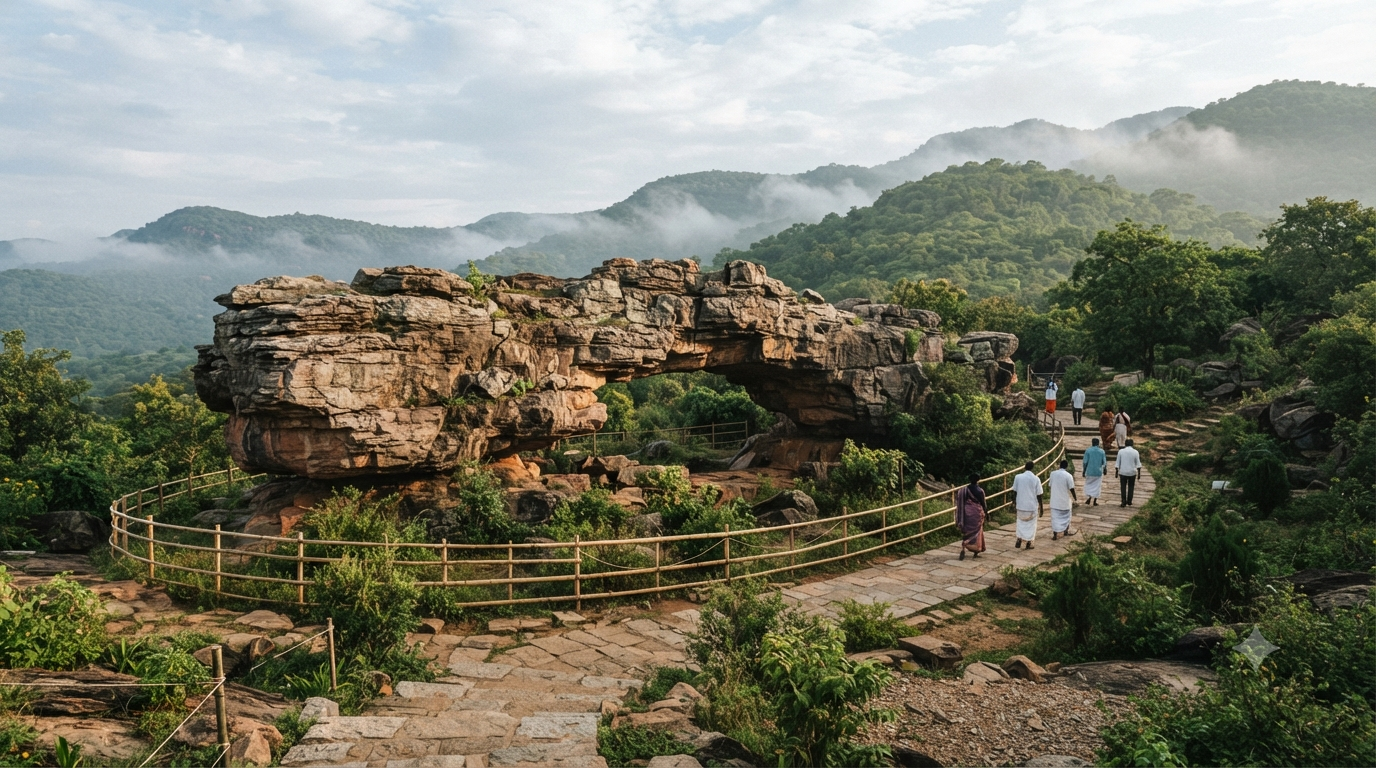
Tirumala Silathoranam is the natural rock arch near Chakra Theertham that many pilgrims miss after darshan. The site combines geology, Tirumala tradition, and an easy short stop on the hill. This refreshed guide gives the current planning window, realistic distance, route choices, history, and legends. It also shows which nearby places fit one trip.
Prayanamam is an independent pilgrimage and travel guide. We are not affiliated with or endorsed by Tirumala Tirupati Devasthanams (TTD). We are not its official website and take no bookings, payments, or donations.
Tirumala Silathoranam at a Glance
Tirumala Silathoranam is a natural arch formed in quartzite rock in the Tirumala Hills. The Tirupati district administration describes it as a notified National Geo-heritage Monument. It places the arch about 1 km north of the Sri Venkateswara Temple area, near Chakra Theertham.
| Detail. | Practical information. |
|---|---|
| What it is. | Natural quartzite rock arch. |
| Officially stated size. | About 8 m wide and 3 m high. |
| Location. | Near Chakra Theertham, Tirumala. |
| Distance. | About 1 km north of the temple in government tourism material; road distance varies by starting point. |
| Current planning hours. | 6:00 AM to 6:00 PM on the Incredible India page. |
| Entry. | No online booking is needed; follow current on-site signage. |
| Best visit length. | About 20 to 40 minutes for the arch and garden area. |
The key correction is the timing. Older pages, including the previous version of this post, list 7:00 AM to 7:00 PM. The Government of India’s Incredible India page currently lists 6:00 AM to 6:00 PM. Use that as the safer planning window, and follow any gate notice on the day.
Tirumala Silathoranam Timings and Best Time to Visit
The current Incredible India listing gives Tirumala Silathoranam opening time as 6:00 AM and closing time as 6:00 PM. Local access can still change during crowd control, maintenance, severe weather, or forest-related restrictions. Therefore, a visit well inside daylight hours is safer than arriving near closing time.
Early morning is the most comfortable period because the hill is cooler and the light is softer. If fog is present, wait a little rather than rushing through. Late afternoon can also be pleasant, although a delayed darshan or heavy Tirumala traffic can quickly eat into your sightseeing time.
How much time should you keep?
Keep 20 to 40 minutes for Tirumala Silathoranam itself. That is enough for a slow look at the arch, the surrounding garden, and the information boards if they are open. Add more time only if you are also walking to Chakra Theertham or continuing towards Srivari Padalu.
Do not build a tight darshan schedule around this stop. Temple reporting times should come first, because a sightseeing delay is not worth risking a timed darshan or seva. If your day includes a fixed slot, our Tirumala darshan late-entry guide explains why you should not cut the timing close.
Why Tirumala Silathoranam Is Geologically Important
Tirumala Silathoranam is not a man-made gateway. Natural weathering and erosion acted on hard quartzite over a vast span of geological time and left the bridge-like rock form standing. The Tirupati district government states that the arch formed in quartzites of the Cuddapah Supergroup.
The same government source gives the arch a width of about 8 metres and a height of about 3 metres. A Government of India parliamentary annexure also lists the Natural Arch at Tirumala Hills. It appears among Geological Survey of India geo-heritage sites. That status is more useful than the claim that it is “one of only three arches in the world.” Many travel pages repeat that line without a sound global comparison.
How old is the rock arch?
Age claims need care because sources often mix the age of the rock with the age of the arch shape. Government tourism material places the host rock in very ancient Precambrian geology. Popular pages, however, quote many different ages for the visible arch. The safest fact is that the quartzite is ancient and the visible arch formed later through long-term erosion.
So do not treat one exact “age of the arch” number as settled. A precise figure needs a clear Geological Survey of India dating method for the formation itself.
Tirumala Silathoranam History: Discovery and Recognition
The modern history of Tirumala Silathoranam is tied to geological work in the Tirumala Hills around 1980. TTD publications and later geo-heritage references describe geologists studying the region and bringing attention to the unusual natural arch. The Geological Survey of India then recognised the Natural Arch at Tirumala Hills as a geological monument.
The old version called this feature a “geological fault,” which is misleading. The arch itself is better described as a natural erosional rock formation. The nearby Tirupati-Tirumala ghat road has a separate geological feature called the Eparchaean Unconformity, and the two should not be confused.
What does “Silathoranam” mean?
In Telugu, “sila” means rock or stone, while “thoranam” refers to a decorative garland or arch over an entrance. The name fits the shape: a stone span connects two larger rock masses like a natural ceremonial arch.
Legends Associated with Tirumala Silathoranam
Geology explains how the rock formed, while Tirumala tradition gives Tirumala Silathoranam a devotional meaning. These stories belong to belief and temple folklore, so they should be read as sacred tradition rather than scientific history.
One tradition says the arch resembles Vaishnava symbols such as the conch and discus. Another says its height has a symbolic connection with Lord Venkateswara. A third tradition links the site to the divine footsteps associated with Srivari Padalu. It then connects the Lord’s journey with the place of the main Tirumala shrine.
The old post also presented a detailed Lakshmi and Bhrigu narrative as a direct historical account. The refreshed version separates that faith tradition from the verified geological record, which keeps both the devotional meaning and the factual history clearer.
Tirumala Silathoranam Route and Distance
Tirumala Silathoranam sits on the north-western side of the Tirumala temple area, near Chakra Theertham and on the side-trip route towards Srivari Padalu. The Tirupati district administration places the landmark about 1 km north of the temple. Your road distance can be longer, depending on the starting point.
This is why different websites quote 1 km, 2 km, or even 3 km. One may measure straight from the temple precinct, another from Tirumala Bus Station, and another along the drivable road. For trip planning, allow roughly 10 to 15 minutes by vehicle from the central Tirumala area when traffic is normal.
Can you walk from the temple area?
Yes, a walk is possible for fit visitors, but the exact distance depends on where you start. From the Varahaswamy Temple side, older guides describe a roughly 20-minute walk, while a route from the bus stand or your accommodation may take longer.
Use a map and stay on public roads and marked paths. Tirumala sits inside a forested hill environment, so do not take shortcuts through vegetation or restricted areas.
Bus, taxi, or private vehicle?
A taxi or local shared vehicle is the simplest option if you are short on time. TTD operates free Dharma Ratham buses around Tirumala, but its current general route description focuses on cottages, Annaprasadam, Kalyanakatta, and darshan complexes. A 2024 TTD news report mentioned free buses to Silathoranam during heavy crowd control. Do not assume that special service runs as a permanent sightseeing shuttle.
If you want the wider theertham circuit, check current transport at Tirumala Bus Station that day. Bus and shared-vehicle arrangements can change. For the wider hill route, our Akasha Ganga route guide explains the common sightseeing corridor.
How to Plan a Short Silathoranam Circuit
The most efficient plan is to group Tirumala Silathoranam with nearby attractions instead of making separate trips across the hill. Start with the rock arch, then add Chakra Theertham if access is open. Continue towards Srivari Padalu only if you have enough daylight and no fixed darshan reporting time.
- Start at Tirumala town or your accommodation. Finish any fixed temple reporting first.
- Visit Tirumala Silathoranam. Keep 20 to 40 minutes for the arch and garden.
- Add Chakra Theertham. It lies close to the Silathoranam area, but expect steps and uneven ground.
- Continue only if time permits. Srivari Padalu, Akasha Ganga, and Papavinasanam need a larger transport window.
- Return before evening. Do not depend on last-minute transport near closing time.
If you want a half-day Tirumala circuit, combine this stop with Papavinasanam and Japali Hanuman Temple. However, forest-road access and local transport can change, so confirm the day’s position before leaving town.
What Most Visitors Get Wrong
The biggest mistake is treating every distance online as a contradiction. Government material places Tirumala Silathoranam about 1 km from the temple. Other Tirumala reference points can make the road trip 2 to 3 km. Always ask, “distance from where?” before comparing figures.
The second mistake is using old opening hours. The previous article printed 7:00 AM to 7:00 PM, but the current Incredible India page lists 6:00 AM to 6:00 PM. The third mistake is assuming a special-event free bus announcement proves a permanent tourist shuttle.
Finally, avoid the “only three natural arches in the world” claim. Natural arches exist in many countries. What makes this site notable is its protected geo-heritage status, ancient quartzite setting, and close cultural connection with Tirumala.
Practical Tips for Visiting Tirumala Silathoranam
- Visit early if possible because the light, temperature, and crowd level are usually better.
- Wear footwear with good grip because rock and garden paths can be uneven after rain.
- Carry water, especially if you plan to continue to Chakra Theertham or other hill stops.
- Respect barriers around the arch. Do not climb on the protected rock formation.
- Keep noise low because the area has both heritage and devotional importance.
- Check current TTD crowd notices before adding sightseeing on a peak festival day.
- Do not pay anyone for a “Silathoranam booking.” This is a sightseeing stop, not a booked darshan product.
Elderly visitors and anyone with knee, balance, or heart problems should be cautious on steps and uneven ground. Carry prescribed medicines, avoid the hottest part of the day, and skip optional walking sections if they feel physically demanding.
Official Sources to Check Before You Go
For basic Silathoranam location and geology, use the Tirupati District religious tourism page. For the currently listed opening hours, see the Government of India Incredible India page.
For Tirumala transport and crowd arrangements, check the official Tirumala Tirupati Devasthanams transport page and current notices on TTD News. If an old blog, video, or WhatsApp message conflicts with an official notice, follow the current official source.
Before You Go
Tirumala Silathoranam is worth the short detour because it adds a very different layer to a Tirumala visit. You see an ancient natural formation, a protected geo-heritage site, and a place woven into local devotional tradition in one stop.
Use 6:00 AM to 6:00 PM as the current planning window. Keep your temple schedule first, and allow extra time for local traffic. Most importantly, treat distance figures as start-point dependent and transport claims as day-specific unless TTD confirms them.
Frequently Asked Questions
What is Tirumala Silathoranam?
Tirumala Silathoranam is a natural quartzite rock arch near Chakra Theertham in the Tirumala Hills. Government tourism material describes it as a notified National Geo-heritage Monument and gives its size as about 8 metres wide and 3 metres high.
What are Tirumala Silathoranam timings?
The Government of India’s Incredible India page currently lists 6:00 AM to 6:00 PM. Older travel pages often show 7:00 AM to 7:00 PM, so use the current government listing as the safer planning window and follow on-site notices.
How far is Silathoranam from Tirumala temple?
The Tirupati district administration places the natural arch about 1 km north of the Tirumala temple. Road distance can be longer from Tirumala Bus Station or accommodation areas. That explains why some travel guides quote 2 to 3 km.
Is there an entry fee for Tirumala Silathoranam?
No online reservation or darshan ticket is required for Tirumala Silathoranam. Current government tourism material does not present it as a ticketed attraction. Follow any local notice if access arrangements change.
How was Tirumala Silathoranam formed?
The arch formed naturally in hard quartzite through long-term weathering and erosion. Water, wind, and other weathering processes exploited weaker parts of the rock, while the more resistant span remained.
Is Silathoranam the same as the Eparchaean Unconformity?
No. Tirumala Silathoranam is the natural rock arch near Chakra Theertham. The Eparchaean Unconformity is a separate geological exposure on the Tirupati-Tirumala ghat road that records a major gap between ancient rock units.
Can I visit Silathoranam and Srivari Padalu together?
Yes, many visitors combine the two because they lie on the same broader side-trip from Tirumala town. However, allow enough time for transport and walking, and do not risk missing a fixed darshan or seva reporting time.
Is the free TTD bus available to Silathoranam every day?
Do not assume that it is. TTD’s general Dharma Ratham route covers key Tirumala town facilities. A 2024 bus report to Silathoranam described a special crowd-control arrangement. Check the current local service at Tirumala before relying on a free sightseeing bus.