📖 17 min read · 3,400 words
A circular journey ticket can cover an Indian Railways tour that starts and ends at the same station. However, buying that ticket does not reserve a seat or berth on every train. Travellers normally need an approved route, a ticket from the relevant station booking office, and reservations for each planned rail leg.
Prayanamam is an independent travel guide, not an Indian Railways or IRCTC website. We do not sell tickets, arrange reservations or collect payments. Use authorised railway offices for circular tickets and official railway channels for travel information.
Circular Journey Ticket at a Glance
- Best suited to: A planned sightseeing or pilgrimage loop with several rail stops and a return to the starting station.
- Route: Choose a railway’s standard circular itinerary or seek approval for your proposed route.
- Purchase: Present the railway’s prescribed authority or fare calculation at the booking office of your starting station.
- Reservations: Approach the reservation office for each intended train leg after obtaining the journey ticket.
- Breaks: The Railway Board permits a maximum of eight journey breaks on circular tickets.
- Endorsements: The Railway Board states that circular tickets do not require break-journey endorsements.
- Price: Railway staff calculate the applicable fare. Do not assume a fixed discount or automatic berth confirmation.
The distinction is simple: one journey ticket can cover an approved circuit, but each train still needs its own reservation arrangement when reserved accommodation is required. Indian Railways explains these procedures in its published passenger guidance on circular-ticket booking.
The eight-break limit and exemption from break-journey endorsements appear separately on page 491 of the Railway Board’s Trains at a Glance 2026.
What Is a Circular Journey Ticket?
A circular journey ticket is an Indian Railways travel ticket for an eligible route that returns to its starting station. It supports a multi-stop tour rather than an ordinary direct or return trip. Zonal railways offer standard routes and also consider passenger-proposed itineraries.
This is useful when your trip has several destinations. For example, a pilgrimage may require a long stay at one stop and onward travel days later. A straightforward point-to-point ticket does not cover the entire loop in the same way.
Yet a circular ticket is not an unrestricted rail pass. Its route, dates, permitted breaks and validity matter. You cannot assume that it covers a route change simply because you reach another railway station.
Circular Journey Ticket Routes: Standard or Custom?
Indian Railways describes two broad ways to plan a circular journey ticket. A standard itinerary follows a route already offered by a zonal railway. A proposed itinerary follows the passenger’s requested route and needs approval from the relevant railway administration before issue.
| Question | Standard Itinerary | Proposed Itinerary |
|---|---|---|
| Who defines the route? | The zonal railway | The traveller proposes it |
| Is fresh route approval needed? | Confirm the standard route’s availability | Railway approval applies |
| Where to confirm it? | Nominated railway station | Division or authorised station manager |
| Are berths included? | No automatic guarantee | No automatic guarantee |
A standard route may spare you a custom itinerary review, but it must fit your actual plan. If it skips a place you need, ask railway staff about a proposed circuit rather than silently adding another stop.
The Indian Railways Commercial Manual, paragraph 269, distinguishes standard itineraries from passenger-proposed routes. It also explains that the railway administration responsible for the starting area approves proposed itineraries.
How to Seek Circular Journey Ticket Itinerary Approval
For a custom route, prepare a full itinerary before visiting the railway office. The division responsible for your proposed starting station is the relevant starting point. Railway authorities review the route and work out its fare. Approval is an administrative step, not a payment screen on a travel website.
- Set your start and finish. Use the same originating station at both ends of the proposed loop.
- List each stop in order. Include the stations where you intend to pause, rather than only town or temple names.
- Note your travel plan. Bring preferred dates, approximate lengths of stay and the class you hope to use.
- Contact the authorised office. Ask the Divisional Commercial Manager or the station manager at a relevant major station how to submit the proposal.
- Obtain the railway’s decision and fare advice. Follow the format the office specifies before attempting purchase.
The railway may suggest corrections if your route or requested breaks do not qualify. Therefore, avoid locking in non-refundable accommodation until the ticket plan is viable.
Confirm the current submission method and expected processing time with the relevant railway office. Indian Railways’ published guidance does not establish a universal online approval deadline for every proposed itinerary.
Where to Buy a Circular Journey Ticket
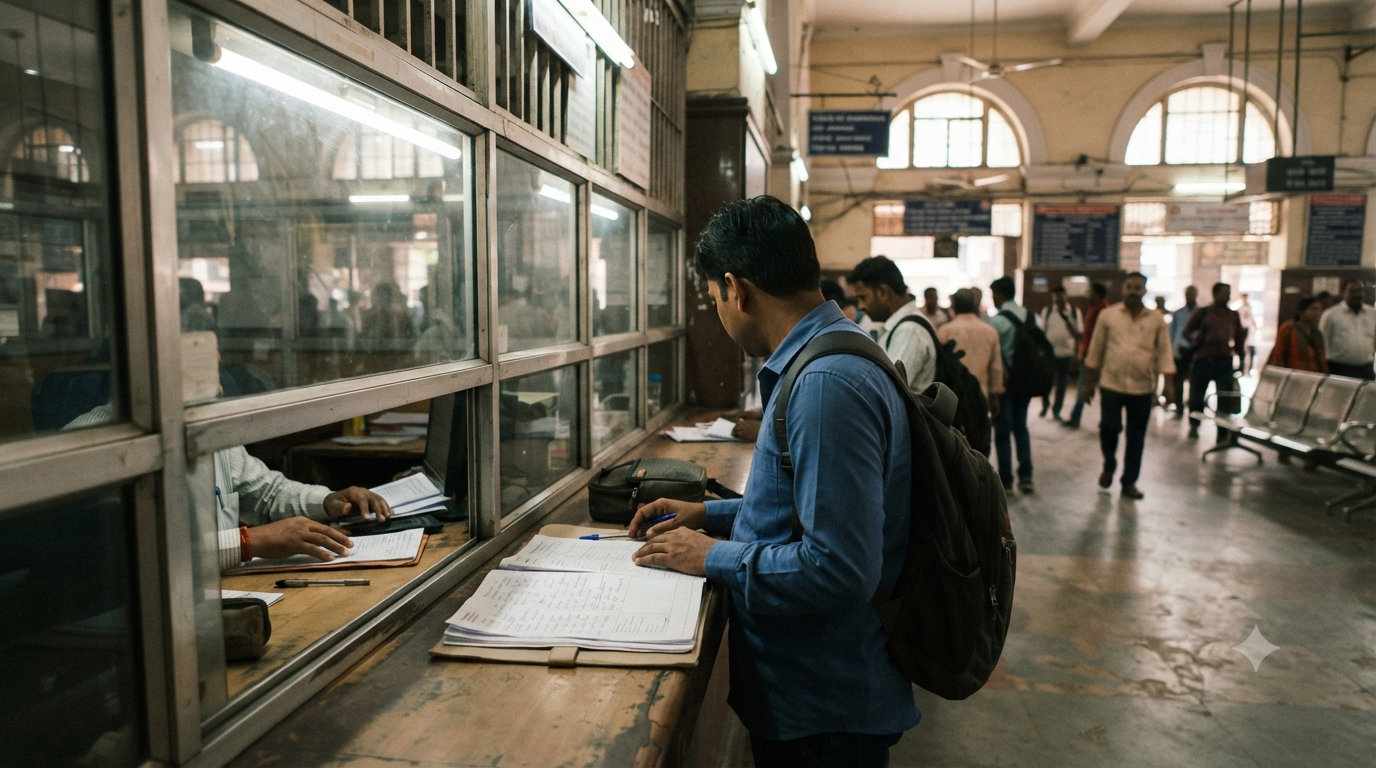
Once railway staff authorise the itinerary and calculate the charge, take the prescribed document to the booking office at your starting station. The booking office issues the travel ticket. The reservation office then handles accommodation for the train segments you intend to take.
Indian Railways presents these as distinct stages. First comes the route and fare decision. Next comes purchase of the circular journey ticket. Only after that do you seek seats or berths for the separate legs.
Ask the station staff which counter handles each stage because facilities differ by station. Also check whether the particular route and travel class can be issued there. Do not assume every small station has staff authorised to approve custom itineraries.
Why Circular Journey Ticket Reservations Are Separate
A circular journey ticket gives travel authority for its approved itinerary, but it does not automatically allocate berths across multiple trains. Indian Railways instructs passengers to approach the reservation office after purchase and reserve accommodation for the various legs. Each train and date therefore needs individual attention.
Suppose your plan is Station A to B, B to C, C to D, then D to A. You must consider four train legs, even though your route forms one circuit. If the second leg has no available sleeper berth, owning the main ticket does not produce one.
Check the actual train, travel date, class, boarding point and destination for every leg. Keep each reservation document alongside the circular ticket.
If you need help interpreting confirmed, RAC or waitlisted status, see Prayanamam’s train chart preparation and PNR status guide.
Changing the Boarding Station for an Individual Leg
A boarding-point change concerns the station where you join a particular reserved train. It does not automatically change the approved circular route. Therefore, travellers should distinguish a reservation-level change from a change to their overall journey itinerary.
For ordinary eligible railway reservations, Indian Railways provides facilities to request a different boarding station. Our IRCTC boarding-point-change guide explains the general rules, deadlines and available channels.
However, do not assume that every online boarding-point-change facility applies to a circular-ticket reservation. Ask the authorised reservation office whether your proposed change is permissible under the ticket and itinerary conditions. Obtain confirmation before boarding from a different station.
A Practical Circular Journey Ticket Planning Example
Consider a traveller who wants to start at Station A, visit three destinations and return to Station A. The route is only an illustration. It is not an approved railway itinerary or a list of available trains.
Its value lies in showing what needs checking before you pay.
| Journey Leg | Travel Plan | Reservation Check |
|---|---|---|
| A to B | First departure | Check train and berth |
| B to C | After the first permitted break | Check a separate reservation |
| C to D | After the second permitted break | Confirm onward accommodation |
| D to A | Return to starting station | Check reservation and validity |
A planning mistake is to focus on the first departure and ignore the last return. Yet the loop must work as a whole. A missing berth near the end can make an otherwise attractive itinerary impractical.
Prepare a paper or digital reference list for your own use before speaking with the booking office. It should show all travel legs, rather than just the names of tourist destinations.
How Much Does a Circular Journey Ticket Cost?
Indian Railways describes telescopic fare treatment for eligible circular journeys, so the calculation can differ from ordinary point-to-point tickets. However, there is no single rupee price or guaranteed saving for every route. The railway calculates the charge after examining your actual itinerary.
The Commercial Manual describes a fare basis equivalent to two single journeys, each representing half the circuit’s total distance. Separate reservation charges and applicable train supplements can also matter. Therefore, ask for the full payable amount, not just a headline base fare.
Do not rely on an online article promising a fixed percentage off, a senior-citizen concession or an instant quotation. Some older railway pages contain concession information that needs current confirmation.
The booking office must verify present eligibility and charges for your case.
Compare the Total Cost Before Paying
A useful comparison includes more than the journey fare. Consider all applicable reservation charges, train supplements and the cost of alternative travel arrangements.
For example, a circular fare may appear attractive until you discover that suitable reserved accommodation is unavailable on an important leg. Changing your travel dates may then affect hotel bookings or other arrangements.
Obtain the railway quotation and compare it with available point-to-point tickets for the same intended journeys. This approach gives you a better basis for deciding than an advertised discount percentage.
Circular Journey Ticket Rules: Eight Breaks and Endorsements
The Railway Board’s Trains at a Glance 2026, page 491, explicitly permits a maximum of eight journey breaks on circular tickets. The same section confirms that passengers do not need break-journey endorsements for these tickets.
Eight is the maximum permitted number, not a requirement to use all available breaks. Your stops must still comply with the authorised itinerary and ticket validity.
An endorsement is a railway official’s confirmation associated with a journey break. Although circular tickets have an exemption from this requirement, passengers must still retain valid travel documents and comply with reservation conditions.
| Rule | Circular Ticket Requirement |
|---|---|
| Maximum journey breaks | Eight |
| Break-journey endorsement | Not required |
| Approved itinerary | Must be followed |
| Reserved accommodation | Separate arrangements for each intended leg |
| Journey completion | Within authorised ticket validity |
These are circular-ticket provisions, not general permissions for ordinary point-to-point tickets. In particular, do not confuse the endorsement exemption with permission to change your route or travel without required reservations.
Validity Period and Length of Stay
The journey has an authorised completion period. Paragraph 269 of the Indian Railways Commercial Manual links validity to journey distance and permitted break days.
Railway staff must establish the relevant validity for your itinerary, so do not estimate it from a casual social-media rule. Also avoid assuming that eight permitted breaks mean unlimited days at each destination.
Before purchase, check the last permitted travel date, all break stations and the authorised route. A long stay at one destination can affect the remaining plan, even when your train reservations exist.
Circular Journey Ticket Versus Separate Train Tickets
A circular journey ticket can suit a settled multi-stop tour, while independent point-to-point tickets may suit a flexible plan. Neither choice guarantees a lower fare or a confirmed berth. The better option depends on route approval, the actual railway quotation and accommodation available on each travel date.
| Factor | Circular Route Ticket | Separate Tickets |
|---|---|---|
| Route planning | Approved circuit | Each journey chosen separately |
| Travel authority | One circular fare arrangement | Point-to-point tickets |
| Seat or berth | Reserve each leg | Reserve each eligible leg |
| Flexibility | Bound by approved route and validity | Depends on each ticket’s rules |
| Price decision | Get an official route quotation | Compare available journey fares |
| Purchase method | Prescribed railway station process | Authorised booking channels |
For a changing schedule, ordinary tickets might be easier to manage. You can review individual options on the official Indian Railway Catering and Tourism Corporation (IRCTC) website.
That link is for supported ordinary online railway services. It is not an online checkout for the special circular-ticket process.
What If the Route or a Reservation Fails?
Neither custom itinerary approval nor a confirmed berth on every chosen train is guaranteed. Your route may need changes, an authorised office may direct you elsewhere, or a popular train may have no accommodation. The appropriate response depends on which part of the process failed.
- Route approval is delayed or declined: Ask the relevant railway commercial office whether a revised route or an available standard circular itinerary qualifies.
- The booking counter cannot issue the ticket: Confirm the authorised issuing station and required documents with the responsible railway office.
- One reserved leg is unavailable: Ask the railway reservation office about another date, class or train that remains consistent with the approved route.
- The full plan no longer works: Request official guidance before changing the itinerary or abandoning the circular fare arrangement. Alternatively, consider independent tickets through authorised railway channels.
If a reservation shows waiting-list status, do not treat it as confirmed accommodation. Our IRCTC current booking guide explains a separate post-charting facility for eligible vacant berths.
However, that facility does not convert a circular ticket into a guaranteed multi-leg reservation. Confirm whether any alternative reservation arrangement is compatible with your existing circular ticket before proceeding.
Luggage Allowance During a Circular Railway Tour
Passengers planning a long circular railway tour should check the baggage rules for their intended travel class. Carrying luggage across several trains also requires more planning than a single direct journey.
A circular ticket does not itself establish a special unlimited luggage entitlement. Therefore, confirm the applicable baggage allowance and any luggage-booking requirements with Indian Railways.
If your travel arrangements involve different classes or trains, ask railway staff which luggage conditions apply. Do this before arriving at the platform with heavy bags.
Our Indian Railways luggage allowance guide explains free baggage limits, excess luggage charges and the official luggage-booking process.
For a multi-stop pilgrimage or sightseeing tour, pack with transfers in mind. Heavy suitcases can make repeated boarding and station changes difficult. Keep essential medicines, identity documents and travel tickets in a small, accessible bag.
When the itinerary includes long breaks, plan how you will handle your luggage between trains. Confirm the availability and eligibility conditions of any station luggage-storage facility separately.
Mistakes That Cause Trouble at the Counter
A circular journey ticket can become difficult to arrange when the initial travel plan is incomplete. Travellers may show a city list without station names. Others expect one confirmed train to secure all later legs.
- Confusing itinerary approval with seat confirmation: Keep the two decisions separate.
- Assuming IRCTC sells a circular ticket in one checkout: Follow the railway’s published station-based purchase procedure.
- Trusting an automatic discount claim: Compare a railway-issued quotation with actual alternatives.
- Leaving dates vague: Choose a realistic travel plan before requesting the fare assessment.
- Changing stops without asking: Seek railway guidance because the approved route controls the ticket.
- Misreading the eight-break rule: The maximum number of breaks does not remove itinerary or validity restrictions.
- Ignoring validity: Check that your final journey falls within the authorised period.
- Assuming luggage is unrestricted: Confirm applicable baggage conditions before travelling.
Bring enough time for the official process before your first train. The office may need to review route details and advise you on reservation availability.
If you are travelling as a group, ask staff how passenger details and reservations should be handled under the applicable rules.
Before Boarding: The Final Document Check
Once you have the circular journey ticket and your train reservations, inspect every travel document. Compare passenger details, stations, journey dates and classes. Then place the applicable reservation proof with the main ticket so staff can check them when required.
- Carry the original circular journey ticket or other valid railway-issued travel authority.
- Keep reservation documents for all intended reserved train legs.
- Check your authorised boarding station for each train.
- Verify the final date of ticket validity.
- Carry the identity documents required for your reservations.
- Keep any applicable luggage-booking receipts.
- Confirm current train running information before departure.
Also confirm the train’s current status through official railway channels before leaving for the station. Keep a margin between connections, especially after a sightseeing or pilgrimage stop.
When plans change, ask the reservation office about relevant ticket and cancellation rules instead of assuming all legs change together.
For identification requirements on reserved trains, Prayanamam’s railway identity-proof guide explains common checks. Follow the official railway instructions for your specific journey and carry the documents they require.
The Bottom Line for a Multi-Stop Rail Tour
A circular journey ticket offers a structured way to cover an eligible rail loop, but ticket issuance and berth reservations remain separate tasks. First, settle the route and obtain railway approval where needed. Next, purchase the ticket through the relevant station booking office and seek reservations for each train leg.
The Railway Board permits up to eight journey breaks without requiring break-journey endorsements for circular tickets. Nevertheless, travellers must follow the authorised route and complete the journey within the ticket’s validity.
Confirm the final fare, permitted stops, luggage conditions and accommodation with authorised railway staff before committing to the tour.
Frequently Asked Questions
Can I Book a Circular Journey Ticket on IRCTC?
Indian Railways’ published circular-ticket procedure directs travellers to railway commercial and station offices, followed by the booking and reservation counters. It does not establish a normal IRCTC circular-ticket checkout. Use IRCTC for supported ordinary bookings, not as proof that it can issue this special journey ticket.
Does One Circular Ticket Confirm Seats on Every Train?
No. The circular ticket covers the eligible journey arrangement, while the reservation office handles accommodation for individual legs. Confirm each train and date separately because one booked berth does not secure the others. Actual accommodation depends on the applicable reservation rules and availability.
Who Approves a Proposed Circular Journey Route?
The railway administration responsible for the area where the trip starts approves proposed itineraries under the Commercial Manual. Begin with the Divisional Commercial Manager or an authorised major station manager. Standard railway-defined routes may follow a different issuance process, so check their availability separately.
How Many Journey Breaks Does a Circular Ticket Allow?
The Railway Board permits a maximum of eight journey breaks on circular tickets, according to Trains at a Glance 2026, page 491. However, the actual stops must fit the approved itinerary and the ticket’s validity. Confirm their treatment when railway staff calculate your route.
Do Circular Journey Tickets Require Break-Journey Endorsements?
No. The Railway Board’s circular-ticket guidance on page 491 of Trains at a Glance 2026 expressly removes the requirement for break-journey endorsements. This exemption applies to circular tickets, not every railway ticket. Passengers must still follow the authorised itinerary and applicable reservation requirements.
Can I Start and Finish at Different Railway Stations?
The published circular journey definition describes an eligible tour that begins and ends at the same station. If your journey finishes elsewhere, ask the railway whether a different ticket arrangement fits. Do not assume that an ordinary one-way multi-stop journey qualifies for the circular-ticket facility.
Is a Circular Journey Ticket Always Cheaper?
No fixed saving is guaranteed. Indian Railways describes telescopic fares, but the payable amount depends on the approved circuit and applicable charges. Obtain the railway’s actual quotation before comparing it with separate point-to-point tickets. Also consider whether suitable accommodation exists for your intended trains.
What Happens If One Leg Is Waitlisted?
A waitlisted reservation does not guarantee a berth. Check its current status and discuss valid alternatives with the authorised reservation office. Changing trains or dates may require staff to review the approved circular route. Do not assume the main journey ticket overrides reservation conditions.
Can I Change My Boarding Point During a Circular Journey?
Ask the authorised reservation office whether a boarding-point change is permissible for your particular circular-ticket reservation. Ordinary boarding-point-change facilities have their own eligibility conditions and deadlines. A change to one train’s boarding station does not automatically authorise a different overall circular itinerary.
Does a Circular Journey Ticket Include Unlimited Luggage?
No special unlimited luggage entitlement follows simply from buying a circular ticket. Passengers should confirm the baggage rules for their travel arrangements, including any class-based allowances and excess luggage-booking requirements. Consult railway staff before carrying heavy or oversized baggage across multiple trains.
Can I Change the Planned Route After Ticket Issue?
Do not assume you can change the route without railway approval. A circular ticket follows a defined itinerary, and changes can affect validity or fare. Ask the railway office handling the ticket before making a different journey or seeking new reservations outside the authorised plan.