📖 10 min read · 1,979 words
Ghatasthapana Muhurat 2026 falls on Sunday, 11 October 2026, the first day of Sharad Navratri in India. For New Delhi, Drik Panchang lists the main morning window from 6:19 AM to 10:12 AM and the Abhijit window from 11:44 AM to 12:31 PM. However, the exact clock time changes by city, so use a local panchang before starting the Kalash Sthapana.
Independent guide: Prayanamam is not affiliated with any temple, panchang publisher, or religious authority. We do not accept puja bookings, donations, or payments.
Ghatasthapana Muhurat 2026 at a Glance
Sharad Navratri begins on 11 October 2026 because Ashwin Shukla Pratipada is the sunrise tithi that day. Drik Panchang gives Pratipada from 9:19 PM on 10 October to 9:30 PM on 11 October for its Delhi calculation. Prokerala also places Ghatasthapana on 11 October, although its displayed clock times are calculated for Ujjain.
| Detail | 2026 information |
|---|---|
| Ghatasthapana date | Sunday, 11 October 2026 |
| Lunar day | Ashwin Shukla Pratipada |
| Delhi morning muhurat | 6:19 AM–10:12 AM |
| Delhi Abhijit muhurat | 11:44 AM–12:31 PM |
| Pratipada in Delhi | 9:19 PM, 10 Oct–9:30 PM, 11 Oct |
| Vijayadashami | Tuesday, 20 October 2026 |
The key correction is simple: do not reuse a 2022 muhurat for 2026. Panchang dates and local sunrise-based windows change each year, while the precise clock time also changes from one city to another.
Why the 2026 Timing Is Different From the Old 2022 Schedule
The previous version of this page listed 26 September 2022 and a 6:11 AM–7:51 AM window. Those figures belong only to the old 2022 event context. They should not be carried forward because Ghatasthapana depends on the current year’s Pratipada tithi and local sunrise.
In 2026, both Drik Panchang and Prokerala place Sharad Navratri Ghatasthapana on 11 October. Their example timings differ because Drik’s cited page is for Delhi, while Prokerala’s default listing is for Ujjain. That difference is expected, not a contradiction.
This location rule matters more than many festival guides admit. A time copied from Delhi may be several minutes away from the correct local window in Hyderabad, Mumbai, Kolkata, or another city.
Ghatasthapana Muhurat 2026 City-Wise Timings
The following Ghatasthapana Muhurat 2026 examples show why one India-wide clock time is misleading. These are city-specific panchang calculations, so choose the city nearest your actual place of worship. If you live elsewhere, enter your city on a panchang site instead of borrowing a time from this table.
| City | Morning window | Abhijit window |
|---|---|---|
| New Delhi | 6:19 AM–10:12 AM | 11:44 AM–12:31 PM |
| Hyderabad | 6:08 AM–10:05 AM | 11:39 AM–12:26 PM |
| Navi Mumbai | 6:31 AM–10:27 AM | 12:01 PM–12:48 PM |
| Kolkata | 5:31 AM–9:26 AM | 11:00 AM–11:47 AM |
| Ujjain | 6:26 AM–10:17 AM | 11:50 AM–12:36 PM |
Drik Panchang states that it calculates Ghatasthapana by local sunrise, midday, and other panchang factors rather than applying one city’s result everywhere. Therefore, the safest practical approach is to verify your city on the same morning or the previous evening.
How to Use the Ghatasthapana Muhurat 2026 Correctly
Traditional guidance prefers Ghatasthapana during the first part of the day while Pratipada is active. Drik Panchang also gives an Abhijit window when the primary period cannot be used. In 2026, Chitra Nakshatra and Vaidhriti Yoga overlap much of the day in its Delhi calculation, so some families may prefer the Abhijit period according to their tradition.
Do not treat a generic Choghadiya slot as an automatic substitute. Drik Panchang specifically notes that its Ghatasthapana calculation follows festival-specific rules. If your family sampradaya follows a different panchang, use that tradition consistently rather than mixing several systems.
What if you miss the Ghatasthapana Muhurat 2026?
If you miss the main morning window, first check whether your local panchang gives a valid Abhijit period on 11 October. If that window has also passed, avoid inventing a late-night catch-up time. Traditions differ, so ask your family priest or follow the rule given by the panchang your household normally uses.
Missing one ritual window does not prevent you from continuing simple Navratri worship. You can still light a lamp safely, offer flowers, recite your usual prayers, and follow the remaining days according to family custom.
What Is Ghatasthapana or Kalash Sthapana?
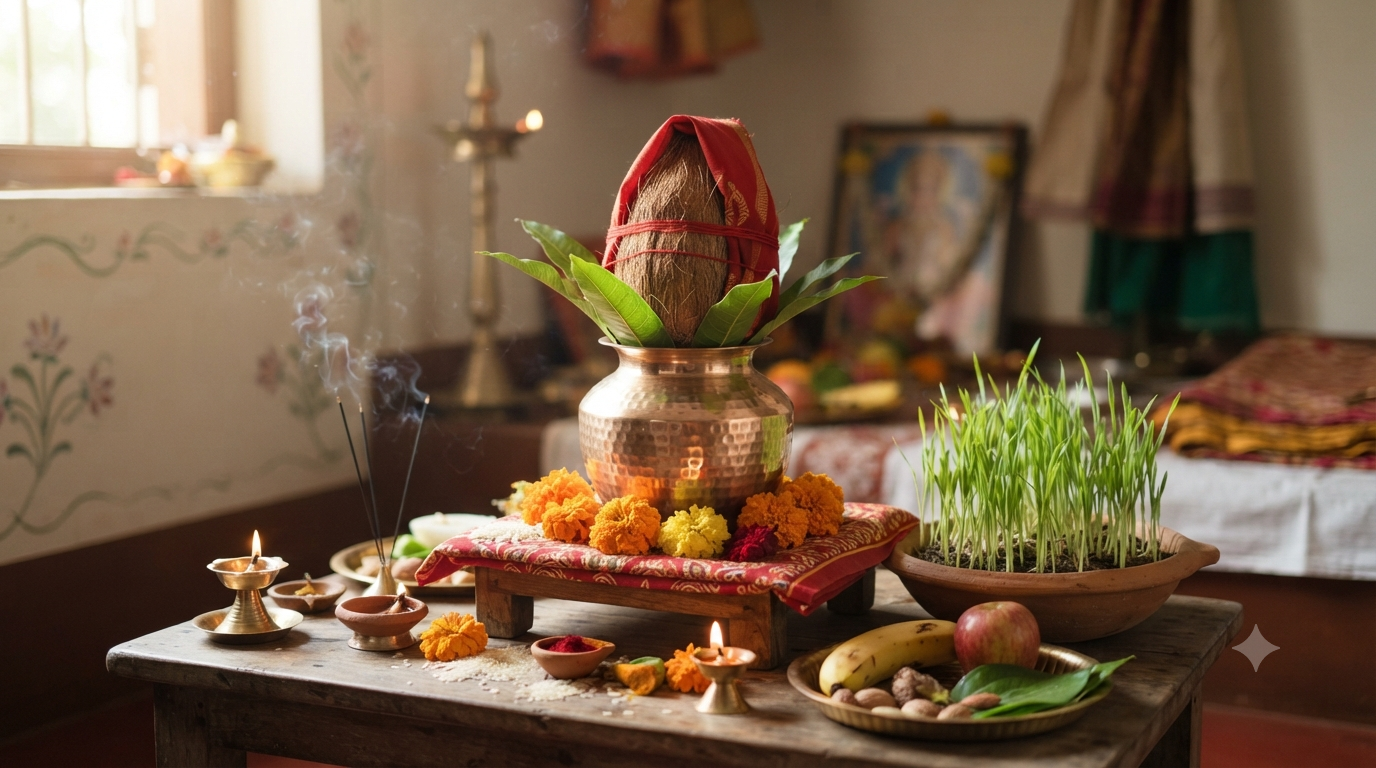
Ghatasthapana, also called Kalash Sthapana, is the ritual installation of a sacred pot at the start of Navratri. The Kalash represents an auspicious seat for the invoked divine presence in many household traditions. It marks the formal beginning of nine days of Devi worship.
Customs vary across regions and families. Some households sow barley around the Kalash, while others use rice, soil, or a simpler altar arrangement. Therefore, treat any single materials list as a common model rather than a universal religious rule.
Ghatasthapana Puja Samagri for Home
A basic household setup usually includes a clean Kalash, water, a coconut, leaves, red cloth, kumkum, akshata rice, flowers, incense, and a lamp. Many families also keep barley or another grain, a small amount of soil, a coin, betel nut, and sacred thread.
Prepare everything before the Ghatasthapana Muhurat 2026 window because searching for items halfway through the ritual causes unnecessary delay. Prayanamam’s Navratri puja samagri list gives a broader planning checklist for home worship.
- Kalash made of copper, brass, clay, or another clean traditional vessel
- Clean water and, where customary, a few drops of Ganga jal
- Coconut, leaves, red cloth, sacred thread, and kumkum
- Flowers, fruits, akshata rice, incense, and a diya
- Soil and barley or other grain if your family tradition uses sprouting
- Simple naivedyam or sweets prepared according to household custom
Step-by-Step Ghatasthapana Puja Vidhi
The exact ritual can differ by lineage, region, and family tradition. The sequence below is a simple home method rather than a substitute for a priest-led procedure. Keep the worship calm and practical, especially if children or elderly family members are participating.
- Clean the puja area. Bathe, wear clean clothes, and prepare a stable altar before the selected local muhurat begins.
- Prepare the base. If your custom uses soil and barley, place them in a shallow vessel and lightly moisten the soil.
- Fill the Kalash. Add clean water and the items your family normally uses, such as a coin or betel nut.
- Arrange the top. Place leaves at the mouth of the Kalash and set the coconut securely above them.
- Make the sankalpa. State your intention for Navratri worship in the form followed at home. You may keep it simple if you do not know a formal Sanskrit sankalpa.
- Invoke Devi with prayer. Offer flowers, kumkum, akshata, incense, and naivedyam. Recite familiar Durga prayers or stotras without rushing.
- Perform aarti safely. Use a stable lamp and keep the flame away from cloth, coconut fibre, children, and pets.
- Continue daily worship. Keep the altar clean during Navratri and offer simple prayers each day according to household custom.
Common Mistakes to Avoid During Kalash Sthapana
The biggest Ghatasthapana Muhurat 2026 planning mistake is using a timing copied from another city or another year. The second is waiting until the muhurat starts before arranging the altar. Prepare the items in advance, then begin within your verified local window.
- Do not copy the old 2022 time into a 2026 calendar.
- Do not present a Delhi, Ujjain, or Mumbai time as universal for India.
- Do not use an unstable pot or overloaded coconut arrangement that may fall.
- Do not leave an oil or ghee lamp unattended.
- Do not turn optional regional customs into rigid rules for every household.
- Do not use fear-based claims if a step differs from your family tradition.
One more practical point: a priest is not mandatory for every household Ghatasthapana. Many families perform a simple Kalash Sthapana themselves. However, if your tradition requires specific mantras, nyasa, or detailed Vedic procedure, follow a qualified priest from your own tradition.
Ghatasthapana opens Sharad Navratri on 11 October. Devotees then continue daily worship through the nine-night observance, with regional differences in deity forms, colours, fasting, and temple programmes. Drik Panchang places Durga Ashtami and Maha Navami on 19 October for the cited 2026 calculations, while Vijayadashami follows on 20 October.
If you are planning the closing-day worship as well, see Prayanamam’s Ayudha Puja 2026 guide. The existing URL still contains 2022, but the article itself has been refreshed for the 2026 festival cycle.
Navratri fasting is a devotional choice, and fasting rules vary widely. A strict fast is not required for everyone. Older adults, pregnant people, children, and anyone with diabetes, kidney disease, or other medical conditions should avoid risky fasting patterns and seek medical advice when needed.
Keep hydration in mind, especially in warm weather. Also use caution with akhand jyoti or long-burning lamps because loose cloth, flowers, and coconut fibre can catch fire. Devotion does not require unsafe practice.
Regional Customs That Can Differ at Home
Ghatasthapana is widely observed, but the household method is not identical across India. Some families sow barley, while others use rice or another grain. The preferred leaves, altar direction, naivedyam, and daily prayer sequence can also change by region and lineage.
That is why a practical guide should separate panchang timing from family custom. The date and local muhurat come from the calendar calculation, while the ritual details often come from inherited practice. If your family method differs from an online checklist, follow your established tradition unless a trusted priest advises otherwise.
For the same reason, avoid treating colours, foods, or fasting rules as compulsory for every devotee. Navratri has strong regional traditions, so a respectful home observance can remain simple and still follow the festival’s devotional purpose.
Before You Set Up the Kalash
For 2026, the date to remember is Sunday, 11 October. Verify your city’s local window rather than copying a national-looking time, and prepare the altar before the muhurat starts. If family custom differs from this general guide, follow the panchang and priest your household normally trusts.
Ghatasthapana Muhurat 2026 is best treated as a local panchang calculation, not a single India-wide clock time. That one distinction prevents the most common scheduling error.
Frequently Asked Questions
When is Ghatasthapana Muhurat 2026?
Ghatasthapana Muhurat 2026 falls on Sunday, 11 October 2026. For Delhi, Drik Panchang gives 6:19 AM–10:12 AM as the morning window and 11:44 AM–12:31 PM as the Abhijit window. Check your city because local times differ.
Is Ghatasthapana on 10 October or 11 October 2026?
Ghatasthapana is observed on 11 October 2026 for the cited Indian panchang calculations. Pratipada begins on the evening of 10 October, but the sunrise-day rule places the Navratri opening ritual on 11 October.
Why does Ghatasthapana time change by city?
The muhurat depends partly on local sunrise, midday, and panchang calculations. Therefore, Delhi, Mumbai, Hyderabad, Kolkata, and Ujjain do not share one identical clock window. Always select your actual city or a nearby location.
Can I do Kalash Sthapana during Abhijit Muhurat?
Many panchang traditions allow the Abhijit window when the preferred morning period cannot be used. In 2026, Drik Panchang lists a separate Abhijit window for Ghatasthapana. Use the local time shown for your city.
Can Ghatasthapana be done at night?
Traditional Ghatasthapana guidance generally avoids night-time installation and prefers the first part of the day while Pratipada is active. If you miss both recognised windows, consult your usual panchang or family priest rather than choosing a random late hour.
Do I need a priest for Ghatasthapana at home?
No, a priest is not required in many household traditions. Families often perform a simple Kalash Sthapana themselves. However, priest guidance is useful when your tradition includes detailed mantras, Vedic procedures, or lineage-specific rules.
What should I put inside the Kalash?
Common items include clean water, a coin, betel nut, and other materials used in your family tradition. Leaves and a coconut are usually placed at the top. Exact contents vary regionally, so do not treat one list as universal.
Can I reuse the 2022 Ghatasthapana time in 2026?
No. The 2022 timing should not be reused because the tithi, sunrise, and festival-day calculation change from year to year. Use a current 2026 panchang for your location.
Fasting is not the only form of Navratri devotion. You can follow simple prayer, sattvic meals, charity, or other family customs instead. If fasting could affect your health, choose a safer observance and seek medical guidance where appropriate.