📖 11 min read · 2,090 words
Shradh 2026 dates begin with Purnima Shraddha on 26 September, while Pitru Paksha proper runs from 27 September to 10 October 2026 in India. The fortnight ends on Sarva Pitru Amavasya, also called Mahalaya Amavasya. The correct day for a family rite depends on the ancestor’s death tithi, not simply on counting days from the start.
This distinction matters in 2026 because Chaturthi and Panchami Shraddha both fall on 30 September in the India calendar used below. Exact tithi boundaries and ritual windows change by location, so check a panchang set to the city where the rite will take place.
Shradh 2026 dates at a glance
- Purnima Shraddha: Saturday, 26 September 2026. It is listed with the season, but it comes before the Krishna Paksha Pitru Paksha sequence.
- Pitru Paksha begins: Sunday, 27 September 2026, with Pratipada Shraddha.
- Two Shraddhas on one civil date: Chaturthi and Panchami both fall on Wednesday, 30 September 2026.
- Maha Bharani: Tuesday, 29 September 2026.
- Magha Shraddha: Wednesday, 7 October 2026.
- Sarva Pitru Amavasya: Saturday, 10 October 2026.
The key planning rule is simple: identify the lunar tithi connected with the ancestor, then use the corresponding Shraddha date. If you only know the civil date of death, ask a knowledgeable family priest or use a reliable panchang to identify the tithi first.
Shradh 2026 dates and tithi-wise calendar
The following Shradh 2026 dates are the India planning calendar. They were cross-checked against location-aware panchang calculations, including Hyderabad and other Indian cities. Families outside India should not copy these dates blindly because tithi boundaries can shift to another civil day in a different time zone.
| Date | Day | Shraddha observance |
|---|---|---|
| 26 September 2026 | Saturday | Purnima Shraddha; before Pitru Paksha proper |
| 27 September 2026 | Sunday | Pratipada Shraddha |
| 28 September 2026 | Monday | Dwitiya Shraddha |
| 29 September 2026 | Tuesday | Tritiya Shraddha; Maha Bharani Shraddha |
| 30 September 2026 | Wednesday | Chaturthi Shraddha and Panchami Shraddha |
| 1 October 2026 | Thursday | Shashthi Shraddha |
| 2 October 2026 | Friday | Saptami Shraddha |
| 3 October 2026 | Saturday | Ashtami Shraddha |
| 4 October 2026 | Sunday | Navami Shraddha |
| 5 October 2026 | Monday | Dashami Shraddha |
| 6 October 2026 | Tuesday | Ekadashi Shraddha |
| 7 October 2026 | Wednesday | Dwadashi Shraddha; Magha Shraddha |
| 8 October 2026 | Thursday | Trayodashi Shraddha |
| 9 October 2026 | Friday | Chaturdashi Shraddha |
| 10 October 2026 | Saturday | Sarva Pitru Amavasya / Mahalaya Amavasya |
A common error is to label 26 September as the first day of Pitru Paksha itself. Purnima Shraddha is observed before the Krishna Paksha fortnight. The main Pitru Paksha sequence begins with Pratipada on 27 September and concludes with Amavasya on 10 October.
Why 26 or 27 September both appear as the start date
Both dates appear online because writers often mix two related ideas. Purnima Shraddha falls on 26 September 2026, while the Pratipada-to-Amavasya Pitru Paksha sequence begins on 27 September. That is why a calendar may show the wider Shraddha period from 26 September without treating Purnima as the first Krishna Paksha tithi.
For planning, do not choose a date merely because a page calls it the “start.” Match the family’s rite to the relevant tithi. The distinction is especially useful when relatives are coordinating priests, travel or food preparation across different cities.
How to use the Shradh 2026 dates correctly
The Shradh 2026 dates are not a numbered appointment list where every family uses the same day. Traditional practice generally connects the annual Shraddha with the lunar tithi on which the ancestor died. The death may have occurred in either Shukla Paksha or Krishna Paksha; the Pitru Paksha rite is then assigned to the matching Shraddha tithi according to the family tradition.
- Find the death tithi. Use an old family record, priest’s record or a panchang calculation based on the date, time and place of death.
- Match that tithi to the 2026 calendar. Do not count forward from 27 September, because two Shraddhas share 30 September.
- Confirm the city. Tithi start and end times depend on location, so select the city where the rite will actually occur.
- Confirm the family procedure. Mantras, the karta, food rules and the order of offerings differ by region, Veda tradition and household custom.
If the tithi is uncertain, avoid guessing from the English date alone. A priest or a location-aware panchang can resolve it more safely than copying a generic festival calendar.
Shraddha timings: Kutup, Rohina and Aparahna
Shraddha timings are location-specific. Traditional panchang guidance commonly gives Kutup Muhurat, Rohina Muhurat and Aparahna Kaal as the preferred daytime windows. These periods move by city because sunrise and the local solar day differ.
For example, the Hyderabad calendar for Sarva Pitru Amavasya on 10 October lists Kutup from 11:39 AM to 12:26 PM, Rohina from 12:26 PM to 1:14 PM and Aparahna from 1:14 PM to 3:36 PM. By comparison, Ujjain timings published for the same date are different. Use these numbers only as examples of why a city-specific check matters.
Before fixing a ceremony, check the location-aware 2026 Shraddha calendar. You can also compare the relevant tithi on Drik Panchang. For the final day, Prokerala’s Mahalaya Amavasya page gives a second location-based timing reference.
Why Shradh 2026 dates need special attention on 30 September
In the 2026 India calendar, both Chaturthi and Panchami Shraddha fall on 30 September. This is sometimes called a tithi-dwayam situation because two relevant lunar tithis meet the same civil date for Shraddha assignment. Therefore, a simple “day four, day five, day six” count produces the wrong calendar from this point onward.
The Shradh 2026 dates table above treats Chaturthi and Panchami as separate observances on the same Wednesday. If two different family Shraddhas fall that day, ask the officiating priest how to order them. One person does not perform two Shraddhas simply because two rows share the date.
Lunar dates do not move by a fixed number of days each year. For another example of this calendar shift, see our Karthika Masam dates and panchangam guide.
Simple Shraddha procedure: what usually happens
Shraddha practice varies widely across families, regions and sampradayas, so no single internet checklist can replace a family’s established vidhi. The outline below explains the common flow in plain language. Follow your family priest when the household tradition differs.
- Prepare and take sankalpa. Bathe, wear clean clothes and prepare the ritual space. The karta states the intention of the rite and the ancestor being remembered according to the family’s custom.
- Perform the prescribed invocations. Some traditions begin with Ganapati, Vishnu or other deva worship before the ancestral rite. The order and mantras vary.
- Offer tarpan. Water, often with black sesame and darbha or kusa grass, is offered with the appropriate ancestral names and mantras where prescribed.
- Offer pinda when the tradition requires it. Pinda daan uses prepared food offerings according to the family’s ritual system. Ingredients and number of pindas are not universal.
- Complete food, charity or feeding customs. Many households include Brahmin bhojan, charity or food offerings according to local practice. Treat these as religious customs, not as guaranteed ways to obtain material outcomes.
- Close the rite respectfully. The priest or senior family member completes the concluding prayers and any remaining tarpan or dakshina customs.
Do not copy unfamiliar mantras from random social posts merely to complete the steps. Pronunciation, gotra details and the ritual order can be tradition-specific, so guidance from a trusted family priest is more useful than a generic script.
What should you prepare before Shraddha?
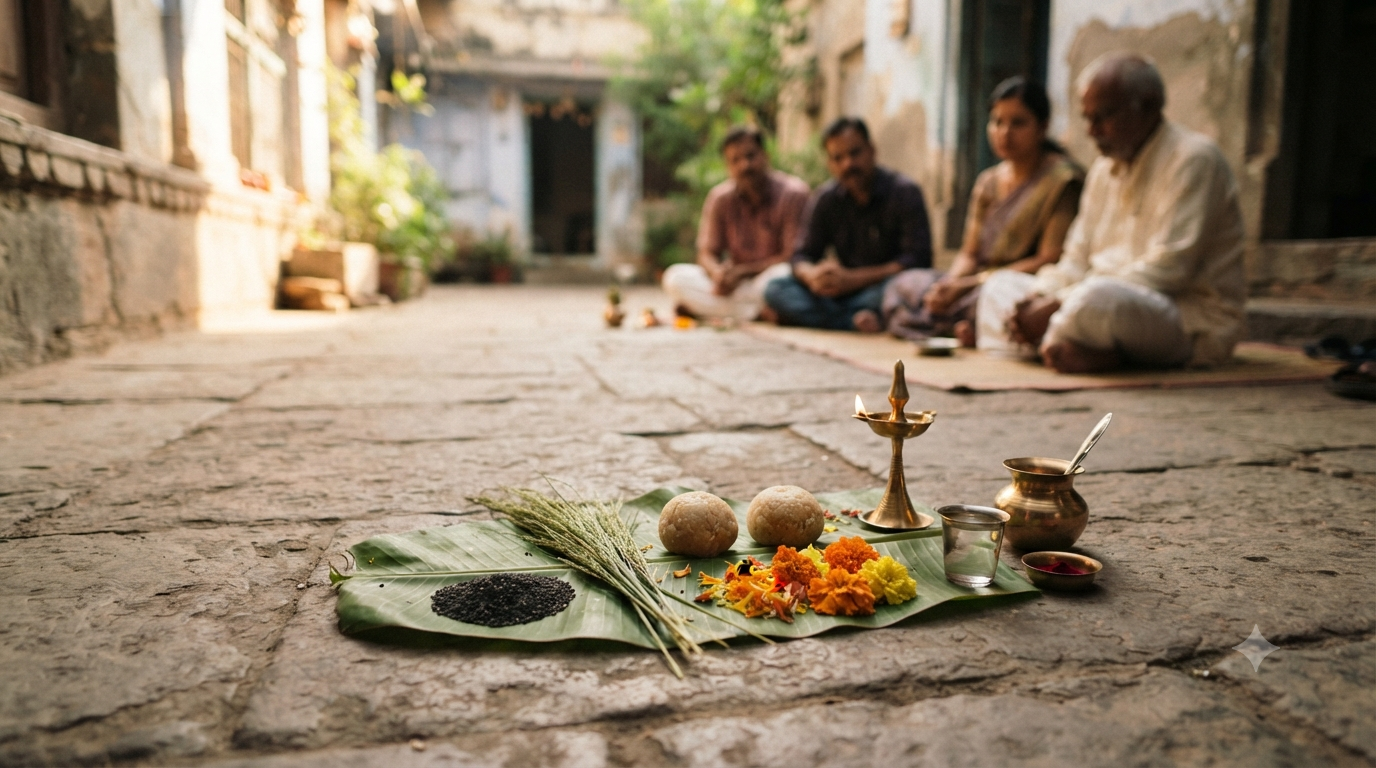
Prepare only after confirming the family procedure because lists vary. Common items may include clean water, black sesame, darbha grass, rice or other food for pinda, flowers, a lamp and the foods used in the household’s customary meal. A priest may ask for additional items based on the rite being performed.
Write the ancestor’s name, gotra and known tithi in advance, since that avoids confusion during sankalpa. Also confirm who will act as karta under your family’s tradition. If several relatives are travelling, agree on the location first because the local panchang determines the exact timing.
Special observances within Shradh 2026 dates
The main Shradh 2026 dates include a few observances that are not merely the next numbered tithi. Maha Bharani in 2026 falls on 29 September because Bharani Nakshatra is relevant during the Shraddha period. Magha Shraddha falls on 7 October and is linked with Magha Nakshatra rather than being another name for every Dwadashi.
Navami Shraddha on 4 October also carries special associations in several traditions, especially remembrance of departed female family members. Chaturdashi has separate traditional rules in some lineages, particularly for certain circumstances of death. Because these rules differ, confirm the correct day instead of relying on a one-line social-media chart.
For readers researching related ancestral traditions and pilgrimage options, Prayanamam also has a guide to Pitru Dosha Nivaran temples in Andhra Pradesh. Treat astrological benefit claims there as matters of religious belief rather than guaranteed outcomes.
What if the death tithi is unknown or you miss the day?
If the exact death tithi is unknown, many traditions use Sarva Pitru Amavasya on 10 October 2026 for collective ancestral remembrance. Families also use the final day when a relevant Shraddha could not be completed earlier, subject to their own tradition and priest’s guidance.
This fallback is why Sarva Pitru Amavasya is especially important in the Shradh 2026 dates calendar. Still, do not assume every special-case rite automatically moves there. Purnima, Chaturdashi, recent deaths and lineage-specific customs can follow particular rules, so confirm the case that applies to your family.
Shradh 2026 dates: common mistakes to avoid
- Calling 26 September the universal first day of Pitru Paksha. It is Purnima Shraddha; the Krishna Paksha sequence begins on 27 September.
- Counting dates forward after 30 September. Chaturthi and Panchami share that civil date, so a simple count shifts later Shraddhas incorrectly.
- Using another city’s clock times. Kutup, Rohina and Aparahna timings are local, even when the civil date stays the same.
- Choosing by weekday instead of tithi. The family rite is traditionally tied to the relevant lunar tithi.
- Treating one procedure as universal. Ritual details differ across regional and family traditions.
- Presenting spiritual results as guarantees. Shraddha is a religious observance based on faith and tradition, not a promise of health, wealth or other measurable outcomes.
Before you fix your family date
The safest way to use the Shradh 2026 dates is to treat the calendar as a planning map, not a substitute for a local panchang. Confirm the ancestor’s tithi, select the city where the rite will happen and then check that day’s local Shraddha window. Finally, follow the family’s established procedure rather than mixing steps from different traditions.
The key dates are 26 September for Purnima Shraddha, 27 September for the start of Pitru Paksha proper and 10 October for Sarva Pitru Amavasya. The shared Chaturthi-Panchami date on 30 September is the detail most likely to cause an avoidable mistake in 2026.
Frequently asked questions about Shradh 2026 dates
When does Pitru Paksha start in 2026?
Pitru Paksha proper begins on Sunday, 27 September 2026 with Pratipada Shraddha. Purnima Shraddha falls one day earlier, on Saturday, 26 September, which is why some calendars display the wider Shraddha period as starting on the 26th.
When does Pitru Paksha end in 2026?
Pitru Paksha ends on Saturday, 10 October 2026 with Sarva Pitru Amavasya, also called Mahalaya Amavasya. The Amavasya tithi itself crosses clock time from 9 October into 10 October, so use a location-specific panchang for the exact ritual window.
Why are Chaturthi and Panchami Shraddha on the same day in 2026?
Both are assigned to Wednesday, 30 September 2026 in the India Shraddha calendar because of the way the two tithis fall across the relevant daytime period. Therefore, you should match the ancestor’s tithi instead of counting one Shraddha per civil day.
Which day should I perform Shraddha for an ancestor?
Traditional practice generally uses the ancestor’s lunar death tithi. First identify that tithi, then match it with the 2026 Pitru Paksha calendar for your location. If the tithi is uncertain, confirm it with a reliable panchang or knowledgeable family priest.
What if I know the death date but not the tithi?
Use the death date, time and place to calculate the lunar tithi. Do not guess from the English calendar date alone because a tithi can begin or end during the civil day. A local panchang or priest can help confirm it.
What if I do not know the ancestor’s death tithi at all?
Many traditions use Sarva Pitru Amavasya on 10 October 2026 for collective Shraddha when the exact tithi is unknown. Family practices can differ, so confirm the appropriate procedure before arranging the rite.
What is the best time for Shraddha in 2026?
Traditional calendars favour the daytime Shraddha periods called Kutup, Rohina and Aparahna. There is no single India-wide clock time because these windows vary by city and date. Check the panchang for the actual place of observance.
Is 26 September or 27 September the correct start date?
Both dates describe different parts of the calendar. Purnima Shraddha is on 26 September, while the Pratipada-to-Amavasya Pitru Paksha fortnight begins on 27 September. For a family ritual, the relevant tithi matters more than the label “start date.”