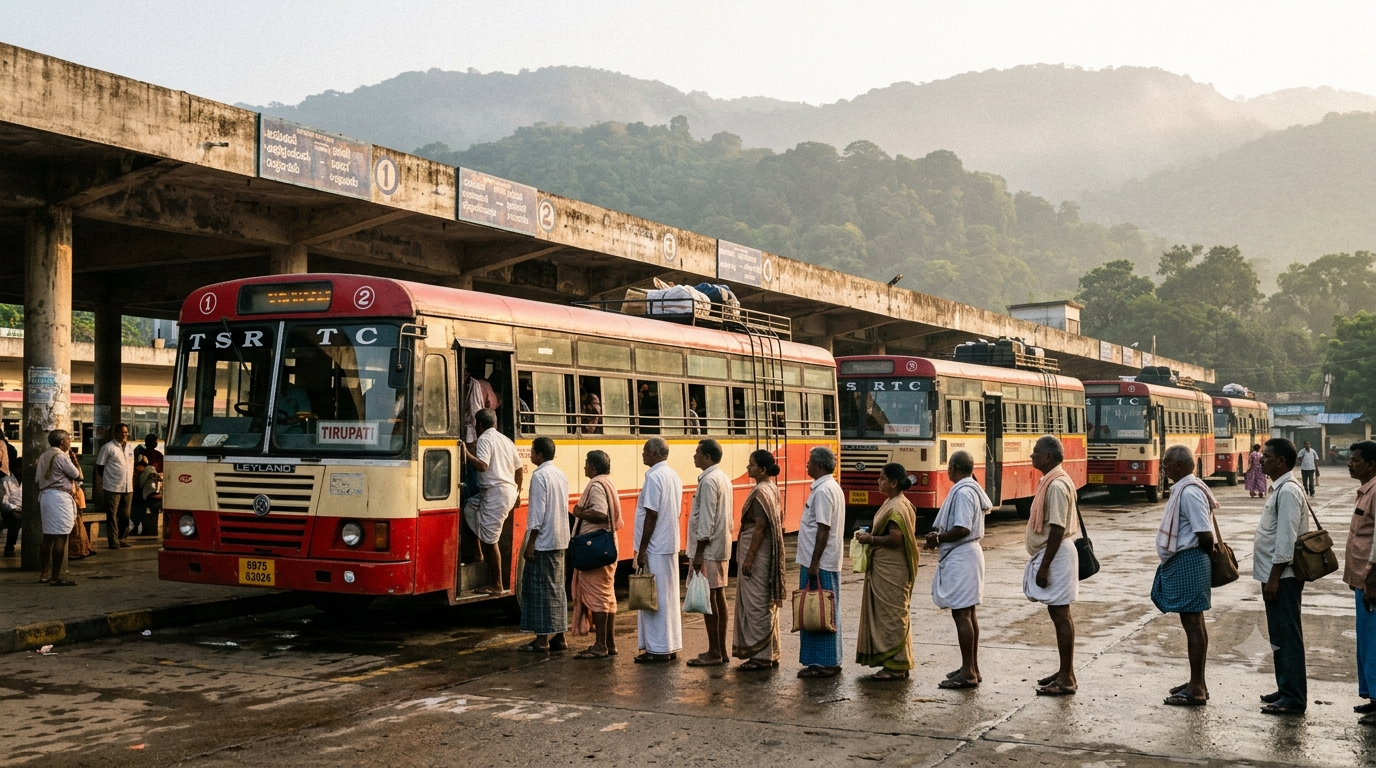
📖 12 min read · 2,254 words
APSRTC Tirumala darshan timings are not a fixed pair of daily slots, even though dozens of travel pages still claim they are. The darshan ticket you download after booking carries your own reporting time. That time shifts with the date and with the quota Tirumala Tirupati Devasthanams (TTD) releases. So the single most useful thing you can do is read that printed time, then work backwards from it.
This guide explains how the slot system really behaves, what the bus leg actually costs, and how much buffer you need before you reach the queue.
Prayanamam is an independent pilgrim guide. We are not affiliated with, endorsed by, or the official website of Tirumala Tirupati Devasthanams or the Andhra Pradesh State Road Transport Corporation. We do not sell tickets, take bookings, or accept payments. Book only on the official portals linked below.
APSRTC Tirumala Darshan Timings at a Glance
Here are the APSRTC Tirumala darshan timings facts most pilgrims need before they open a booking page. We checked each one against an official source, and we flagged every changeable figure.
- Slot structure: no fixed 11:00 AM and 4:00 PM pair; the reporting time is printed on your individual darshan ticket.
- Darshan category: TTD Special Entry Darshan, also called Seeghra Darshan, priced at ₹300 per person.
- Reporting point: the ATC Car Parking area beside the Vaikuntam Queue Complex in Tirumala, as printed on the ticket.
- Bus fare, Tirupati to Tirumala: ₹90 adult and ₹50 child one way, per TTD’s official transport page.
- Return ticket: ₹160 adult and ₹90 child, valid for three days from purchase.
- Ghat road: the up road is 17.80 km; roads normally run from 3:00 AM to midnight.
- Where to book: the official APSRTC portal for the bus, and the official TTD portal for darshan.
The APSRTC Tirumala Darshan Timings Myth Everyone Repeats
Search this topic and you will meet the same claim repeatedly. Pages state that APSRTC runs exactly two darshan slots, one near 11:00 AM and one near 4:00 PM. That framing is tidy, and it is wrong.
Neither TTD nor APSRTC publishes a two-slot schedule. TTD introduced Special Entry Darshan on 21 September 2009 and opened advance booking in August 2014. Its own page routes all slot selection to the booking portal, not to a published timetable. Because TTD releases slots against a daily quota, the times on offer shift with the calendar.
Real tickets bear this out. A Special Entry Darshan receipt shows a specific reporting time, such as 2:00 PM, plus the instruction to report at the ATC Car Parking area. So a pilgrim who plans around a rumoured 11:00 AM slot can miss an actual 9:00 AM window. That single misreading costs people their darshan, which is why this correction leads the guide.
How APSRTC Tirumala Darshan Timings Actually Work
The APSRTC booking flow bundles a bus seat with a TTD ₹300 Special Entry Darshan ticket when quota is available. TTD has historically offered roughly 1,000 such tickets per day through this channel. That number reflects an operational allocation, not a published guarantee. So treat it as indicative, and confirm what the checkout page shows.
Once payment clears, you receive two separate documents. The bus e-ticket comes first. The darshan ticket downloads separately, and most guides skip that step entirely. Understanding this split matters more than memorising any list of APSRTC Tirumala darshan timings.
Reading APSRTC Tirumala darshan timings on your ticket
Your darshan ticket carries three things that matter: the date, the reporting time, and the reporting location. Report inside that window, because TTD manages queue flow through structured entry batches. Arriving hours early rarely helps, since staff turn away pilgrims before their window opens.
Late arrivals face a stricter outcome. Multiple pilgrim accounts describe staff refusing entry well beyond the window, with no refund and no rescheduling. Sources differ on how much grace staff actually allow. So treat the printed time as firm rather than approximate.
Why the reporting point matters
Most Special Entry Darshan tickets direct pilgrims to the ATC Car Parking area near Vaikuntam Queue Complex-I. Some sources instead mention VQC-II, and the assignment can change with crowd management. Follow whatever your ticket prints, and ignore secondhand advice about which gate to use.
Booking the Bus and the Darshan Ticket Together
APSRTC sells this combination through its own reservation system. The add-on appears only when TTD quota is open, so some dates show travel alone. Here is the sequence, including the download step that trips up first-timers.
- Open the official APSRTC reservation portal at apsrtconline.in or the APSRTC app.
- Enter your boarding city and set the destination, then choose your travel date.
- Check availability, and look for a service that flags a TTD ₹300 Special Entry Darshan option.
- Select the darshan slot offered for that service, because this determines your reporting time.
- Enter every passenger’s name, age and government photo ID exactly as it appears on the document.
- Pay online, then download the bus e-ticket immediately.
- Return to the portal, enter your ticket number and the mobile number used at booking, and submit.
- Use the darshan ticket print option to download the TTD ticket separately, then save or print it.
That seventh and eighth step catch people out constantly. Pilgrims arrive holding only a bus ticket, assume it doubles as darshan entry, and discover otherwise at the reporting point.
Planning Your Day Around APSRTC Tirumala Darshan Timings
Once you know your reporting time, plan in reverse. The climb from Tirupati wrecks more schedules than anything else, because ghat traffic swells without warning on weekends and festival days. Sensible planning around APSRTC Tirumala darshan timings starts on the plains, not on the hill.
TTD’s official transport page records the up ghat road as 17.80 km and the down road as 18.00 km. Buses run from Tirupati Railway Station, RTC Central Bus Station, Sri Padmavathi Bus Station and Balaji Link Bus Station. Frequency follows pilgrim arrival patterns rather than a fixed clock.
| Printed reporting time | Leave Tirupati by | Why this buffer |
|---|---|---|
| 9:00 AM | 6:30 AM | Morning bus queues at Tirupati are longest |
| 12:00 noon | 9:30 AM | Mid-morning ghat traffic builds steadily |
| 3:00 PM | 12:30 PM | Lunch-hour crowds slow boarding |
| 6:00 PM | 3:30 PM | Evening light and security checks add delay |
These are planning buffers, not official rules. A two-and-a-half hour cushion covers the bus wait, the roughly one-hour climb, the walk to the reporting point and a luggage deposit. Trim it only if you are already staying in Tirumala.
What the Journey Actually Costs
Cost transparency is where most pages covering APSRTC Tirumala darshan timings go vague. TTD publishes the hill fares directly, so these figures hold firm at the time of writing.
| Item | Adult | Child |
|---|---|---|
| Tirupati to Tirumala, one way | ₹90 | ₹50 |
| Return ticket, valid three days | ₹160 | ₹90 |
| Special Entry Darshan ticket | ₹300 | ₹300 from age five |
Stating it plainly: the hill leg costs ₹90 for an adult one way, and the darshan ticket adds ₹300 per person. Long-distance fares from your home city sit on top and vary by route and service class. Fares and fees change, so confirm the current amount on the official portal before you pay.
What Happens If You Miss Your Reporting Time
Missing the window is the single most common failure on this trip. The ticket ties to a named person and a fixed slot. So you cannot transfer it, and you cannot move it to a later batch. Refunds are not the norm.
Your realistic fallback is free Sarva Darshan, which requires no ticket but involves a substantially longer wait. Some pilgrims also check current darshan waiting time updates before deciding whether to join that queue. Plan the fallback before you travel, not while standing at a closed gate.
Health and Safety Notes for the Hill Leg
Tirumala sits high, and the day is longer than most visitors expect. Queue stretches inside the complex can hold pilgrims for hours, so treat this as a physically demanding outing rather than a short temple stop.
Carry water and any regular medication in a small bag, since large luggage cannot enter the queue. If you plan to walk up via Alipiri, note that the footpath runs 7.80 km and takes roughly three hours. The Srivarimettu route covers 2.10 km in about ninety minutes. Anyone who is elderly, pregnant, or managing a heart or joint condition should speak to a doctor before choosing the footpath over the bus.
TTD publishes an assistance line for vehicle breakdowns on the ghat roads at 0877-2263636 and 9000503089, alongside 108 for ambulance support. Save those before you set out, because mobile signal on the ghat is patchy in places.
How to Spot a Fake Darshan Booking Portal
Fraudulent darshan sellers remain a persistent problem around Tirumala, and they target exactly this search. Anyone hunting for APSRTC Tirumala darshan timings will meet a few. A convincing fake site copies TTD branding, publishes a WhatsApp number, and asks for an upfront processing fee.
Three checks protect you. First, confirm the domain: official TTD booking runs on a government address, and APSRTC reservations run on the corporation’s own portal. Second, refuse any seller who quotes more than ₹300 for a Special Entry Darshan ticket, because TTD sets that price. Third, never send money to a personal account or a private number, however official the messaging sounds.
Verify helpline numbers on the official TTD contact page rather than trusting a number listed on a blog. Several widely circulated numbers conflict with each other, which is precisely how touts intercept calls.
APSRTC Tirumala Darshan Timings: Mistakes First-Timers Make
- Treating the bus ticket as darshan entry. They are two documents, and you must download the second one separately.
- Booking IDs loosely. Names must match the original photo ID exactly, since verification happens at the reporting point.
- Arriving far too early. Entry before your window opens is normally refused, so extra hours at the gate buy nothing.
- Carrying electronics into the queue. Phones and cameras go into deposit counters, which adds time you have not budgeted.
- Ignoring the dress code. Traditional attire is expected at checkpoints, and disputes there eat into your slot.
- Assuming quota exists. The darshan add-on appears only on some dates, so always keep a backup ₹300 ticket availability plan.
Before You Book
The core discipline behind APSRTC Tirumala darshan timings is simple. Book the bus and the darshan add-on on official channels only, download both documents, and let the printed reporting time drive your day. Give yourself roughly two and a half hours between leaving Tirupati and reaching the reporting point.
Add more during festivals. Confirm current fares and quota on the official portals, because these figures move. If the add-on is unavailable for your date, book travel separately, then try the TTD portal directly for Special Entry Darshan and seva tickets.
APSRTC Tirumala Darshan Timings: Frequently Asked Questions
What are the APSRTC Tirumala darshan timings?
There is no fixed published timetable. The TTD Special Entry Darshan slot attached to your booking sets the APSRTC Tirumala darshan timings, and the reporting time appears on the ticket you download. Available slots vary by date and quota. So check what your own ticket prints rather than trusting a general schedule.
How early should I reach the reporting point?
Reach the reporting point within the window printed on your ticket, and plan to be in Tirumala comfortably before it opens. Most pilgrims allow about two and a half hours from Tirupati, covering the bus wait, the ghat climb and the walk across. During festivals, add more.
Is the APSRTC darshan ticket the same as a TTD ticket?
It is a TTD Special Entry Darshan ticket, sold through APSRTC’s booking flow against an allocated quota. The ₹300 price and the darshan rules come from TTD. APSRTC simply provides a combined checkout, and you still download the TTD ticket as a separate document.
What does the bus to Tirumala cost?
TTD’s official transport page lists the Tirupati to Tirumala fare at ₹90 for adults and ₹50 for children. A return ticket costs ₹160 for adults and ₹90 for children, and it stays valid for three days. Confirm current fares before travelling, since rates change.
Can I change my darshan slot after booking?
Generally no. TTD issues these tickets against a named pilgrim and a fixed slot, and they do not transfer. Any change depends entirely on APSRTC and TTD rules at the time. So check the official portal before you assume a swap will work.
Do I need identity proof?
Yes. Every pilgrim needs an original government photo ID such as Aadhaar, a passport or a driving licence. Details entered at booking must match the document exactly, because verification happens at the reporting point and mismatches cause refusals.
What if the darshan option does not appear at checkout?
That usually means TTD quota has closed for your date, so the APSRTC Tirumala darshan timings option simply will not display. Book the bus separately, then try the official TTD portal for a Special Entry Darshan ticket. Free Sarva Darshan still needs no ticket, although the wait runs considerably longer.
Are APSRTC Tirumala darshan timings different during festivals?
Availability tightens sharply during Brahmotsavam, Vaikunta Ekadasi and weekend peaks, and TTD may adjust queue operations. Even so, the reporting time on your ticket still governs your entry. Book earlier than usual, and build extra travel buffer into festival trips.
Where should I book so I avoid scams?
Use the official APSRTC reservation portal for the bus and the official TTD booking portal for darshan. TTD’s own Special Entry Darshan page and its Tirupati to Tirumala transport page confirm the official process and fares. Avoid any agent who asks for a fee above ₹300.