📖 11 min read · 2,183 words
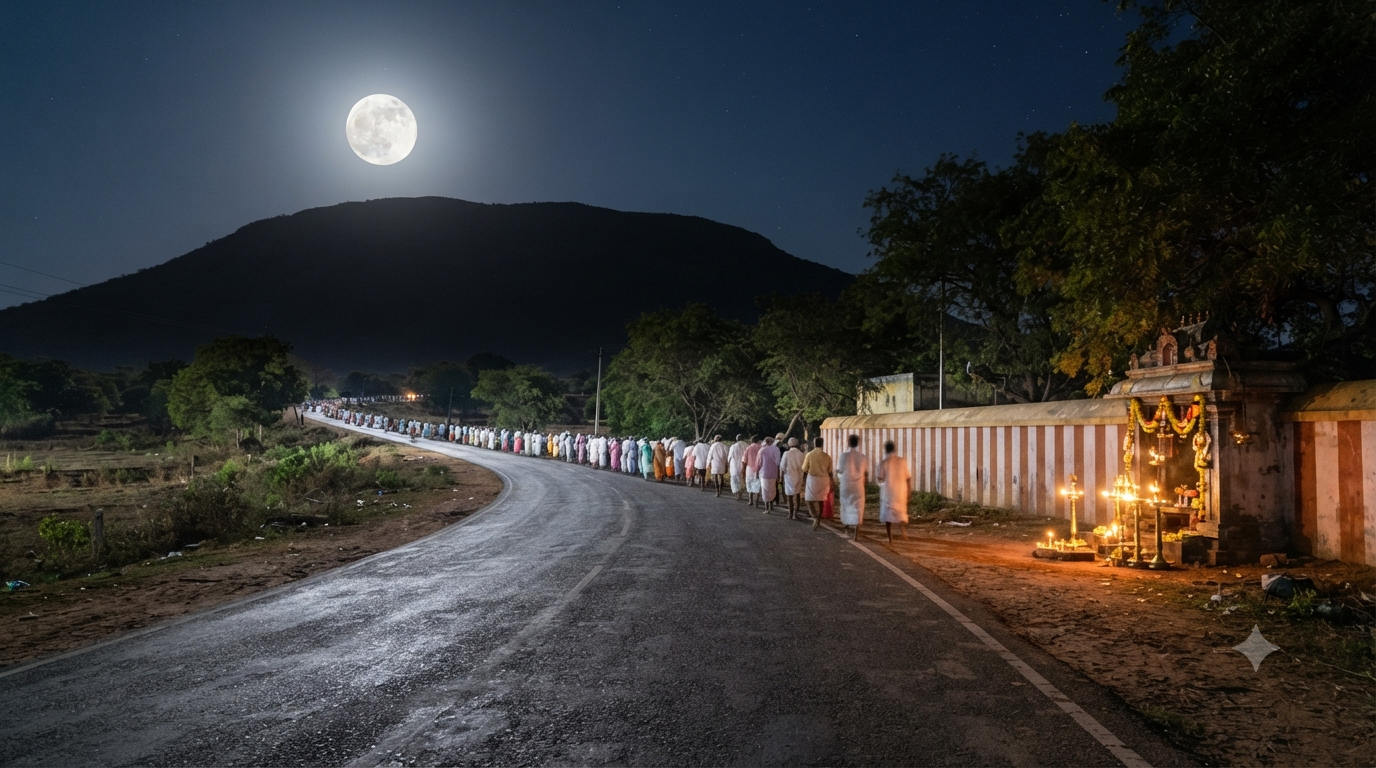
The Tiruvannamalai Girivalam dates for 2026 do not always match the day your phone calendar marks as the full moon. That one gap sends pilgrims to Arunachala on the wrong night. Pournami is a tithi, not a calendar square. It starts and ends at a clock time, so the night you walk is the night the tithi runs.
Below you will find every 2026 walking night with verified timings. You will also see which months the popular lists get wrong, and what changes around Karthigai Deepam.
Prayanamam is an independent pilgrimage guide. We are not affiliated with the Arulmigu Arunachaleswarar Temple or the Tamil Nadu Hindu Religious and Charitable Endowments (HR&CE) Department, and this is not their official website. We take no bookings, donations or payments. Girivalam is free and needs no ticket, so use the official Arunachaleswarar Temple website for darshan or seva arrangements.
Tiruvannamalai Girivalam Dates 2026 at a Glance
Here are the Tiruvannamalai Girivalam dates and details that matter most right now.
- Next walking night: Friday, 25 September 2026, the Purattasi pournami.
- Nights left this year: 25 September, 25 October, 23 November and 23 December.
- Biggest night: Karthigai Deepam on Tuesday, 24 November 2026, when the Maha Deepam burns on the hill.
- Unusual year: an extra lunar month gives 2026 thirteen pournamis instead of twelve.
- The route: about 14 km of flat road, three to five hours barefoot, open 24 hours, free, no booking.
Full Tiruvannamalai Girivalam Dates 2026 Calendar
The table below lists the complete set of Tiruvannamalai Girivalam dates for 2026. Each row gives the pournami tithi window in Indian Standard Time and the night devotees actually walk. We took these timings from panchangam sources and cross-checked them against the Tiruvannamalai girivalam calendar. Tithi times still shift slightly by location, so confirm locally before you travel.
Tiruvannamalai Girivalam Dates: January to June 2026
| Pournami | Tithi window (IST) | Girivalam night | Note |
|---|---|---|---|
| Margazhi | 2 Jan, 6.11 PM to 3 Jan, 4.07 PM | Fri 2 January | Past. |
| Thai | 1 Feb, 5.34 AM to 2 Feb, 4.05 AM | Sun 1 February | Past. |
| Masi | 2 Mar, 5.59 PM to 3 Mar, 5.21 PM | Mon 2 March | Past. |
| Panguni | 1 Apr, 7.23 AM to 2 Apr, 7.44 AM | Wed 1 April | Past. |
| Chithirai | 30 Apr, 9.50 PM to 1 May, 11.07 PM | Thu 30 April | Chitra Pournami. |
| Vaigasi | 30 May, 12.58 PM to 31 May, 2.50 PM | Sat 30 May | Extra month. |
Tiruvannamalai Girivalam Dates: July to December 2026
| Pournami | Tithi window (IST) | Girivalam night | Note |
|---|---|---|---|
| Aani | 29 Jun, 4.23 AM to 30 Jun, 6.00 AM | Mon 29 June | Past. |
| Aadi | 28 Jul, 7.27 AM to 29 Jul, 8.54 AM | Tue 28 July | Past. |
| Aavani | 27 Aug, 9.46 AM to 28 Aug, 10.22 AM | Thu 27 August | Past. |
| Purattasi | 25 Sep, 11.06 AM to 26 Sep, 10.44 AM | Fri 25 September | Next one. Weekend crowd. |
| Aippasi | 25 Oct, 11.25 AM to 26 Oct, 10.09 AM | Sun 25 October | Weekend crowd. |
| Karthigai | 23 Nov, 11.00 AM to 24 Nov, 9.00 AM | Mon 23 November | Deepam week. |
| Margazhi | 23 Dec, 9.57 AM to 24 Dec, 7.40 AM | Wed 23 December | Year end. |
Nights Still Ahead in 2026
Four walking nights remain. They begin with Friday 25 September and close with Wednesday 23 December. Two of them fall on a Friday and a Sunday, so 25 September and 25 October will draw heavier crowds than a midweek pournami.
Why Tiruvannamalai Girivalam Dates Shift Before the Full Moon
This is the most useful thing to understand about the Tiruvannamalai Girivalam dates, and almost no listing explains it. A tithi is a lunar phase segment, not a day. Purnima tithi can open at noon on one date and close the next morning. Because the walk happens at night, devotees set out on the evening when the tithi is live.
Take November. The Karthigai purnima tithi opens around 11 AM on 23 November and closes around 9 AM the next morning. So the pournami walk belongs to the night of 23 November, although several calendars print 24 November as the full moon day. Both entries describe the same tithi.
Only one of them, though, tells you which evening to be on the path. That is the difference between a calendar entry and a plan.
Generic full-moon lists cause a second problem. Some sites appear to calculate later months by adding roughly 29 days to an earlier date. They do not check each month separately, so the list drifts. That is why you will find 2026 lists carrying 29 July, 26 September, 26 October and 24 December.
The tithi actually opens on 28 July, 25 September, 25 October and 23 December. Those same lists usually drop the second May full moon altogether.
Karthigai Deepam 2026 Falls on 24 November
Karthigai Deepam at Tiruvannamalai lands on Tuesday, 24 November 2026. The ten-day Karthigai Brahmotsavam runs from 15 November to 24 November. Priests light the Bharani Deepam inside the temple in the early hours of the final day. The Maha Deepam then burns on the hilltop from about 6 PM, fed by several thousand kilograms of ghee.
Planning gets tricky here, because two big nights sit back to back. The pournami tithi covers the night of 23 November, while the Deepam flame glows from the evening of 24 November. Lakhs of pilgrims walk on both.
So choose deliberately. If you want the traditional pournami walk, pick 23 November. If you want the lit hill above you, pick 24 November. A few calendar sites list Deepam on 25 November.
The temple’s own festival schedule ends on 24 November, so treat that as the date. Confirm it on the official temple site before you book travel.
The Extra Lunar Month That Reshaped 2026
2026 is an adhika masa year, which means the Hindu calendar inserts an extra lunar month. The Vaigasi pournami of 30 May falls inside Adhika Jyeshta. Because of that insertion, the year holds 13 pournamis rather than 12. Two full moons land between 30 April and 30 May.
This matters more than it sounds. Anyone who copies last year’s list forward will be wrong by close to a month for the second half of the year. Leap-month drift is the commonest source of bad festival dates online. That is exactly why we verified every one of the Tiruvannamalai Girivalam dates above for 2026 on its own, rather than shifting them from 2025.
What Time Should You Start the Walk?
Start either well before the evening surge or long after it. Every one of the Tiruvannamalai Girivalam dates above marks a night, not a daytime slot. The pre-dawn stretch from about 3.30 AM to 6 AM is cool and quiet, and tradition treats it as the most potent hour. Alternatively, set off before 5.30 PM and finish before the heaviest inflow arrives.
Most pilgrims need three to five hours for the 14 km circuit. That assumes a devotional pace with pauses at the Ashta Lingam shrines. The road stays flat throughout, so no climbing is involved. Avoid the 10 AM to 4 PM window entirely, since the tar heats up badly and most devotees walk barefoot.
What the District Sets Up on a Big Pournami
Tiruvannamalai runs a serious operation on large pournami nights, and knowing the layout saves hours. For Chitra Pournami in 2026 the administration set up 16 temporary bus stands across the town. It also marked around 90 designated parking locations along the main approach roads, with free shuttle buses linking them to the temple area.
Police route buses by direction. Services from Vellore, Tirupati and Chittoor stop at Anna Arch bus stand. Buses from Chennai and Puducherry use the New Central Bus Stand on Tindivanam Road. Officers also ban roadside parking on these nights and tow offenders, so use an approved zone.
A few rules catch first-timers out. Do not light camphor along the girivalam path. Unauthorised food distribution needs permission. Medical camps and police help booths sit at intervals along the route, so note the nearest one when you start.
Walk Safely: A Note Before You Go
Fourteen kilometres barefoot on a warm night is a real physical demand, and the crowd makes it harder. Carry water and drink steadily, because dehydration stops more pilgrims midway than anything else. Keep any regular medication on you rather than in a bag left behind.
Elderly pilgrims, pregnant women, and anyone with a heart, joint or blood-pressure condition should speak to a doctor first. Walking a shorter stretch and returning is perfectly acceptable. Girivalam is a devotional practice, not a medical treatment, so never substitute it for professional care.
What Can Go Wrong, and What to Do Instead
Girivalam is not guaranteed on any given night. Authorities have restricted or suspended pournami girivalam before, when crowd, security or public-health conditions demanded it. You book nothing in advance, so no ticket protects you.
- Authorities restrict the path that night. Walk on another day instead, since the route stays open around the clock all year. A non-pournami morning is far calmer.
- Rooms run out. Tiruvannamalai fills completely for Deepam. Look at Chengam, Vandavasi or Vellore and travel in, or plan for the next month’s pournami.
- You arrive late and the road jams. Wait it out, then start between 1 AM and 6 AM once the surge thins.
- You cannot finish the 14 km. Rest at a shrine, then exit at the nearest road junction. Auto-rickshaws work the outer stretches on busy nights.
Insider Points Most Girivalam Lists Skip
Walk with the hill on your right. The circuit runs clockwise, and devotees traditionally start from the Raja Gopuram of the Arunachaleswarar Temple after worshipping Vinayagar. Eight Ashta Lingam shrines mark the directions along the way. Stopping at each is what stretches a three-hour walk into five.
Two details save real trouble on the Tiruvannamalai Girivalam dates that draw the biggest crowds. First, police divert vehicles off the girivalam road, so a car parked “close by” may sit a long walk from where you finish. Second, temple staff distribute the ash left after the Maha Deepam much later, not on Deepam night, so do not queue for it that evening.
Tiruvannamalai Girivalam Dates 2027: What Is Known So Far
Panchangam publishers and the Tiruvannamalai girivalam calendars usually release the next year’s tithi timings around December. No publisher has issued a verified 2027 calendar yet, so this guide lists no 2027 dates. Anything circulating for 2027 today almost certainly comes from adding lunar cycles forward, which is the very method that produces wrong dates.
Check back after the December 2026 pournami. You can also confirm on Drik Panchang once the 2027 tithi tables go live. We update this page as soon as two independent panchangam sources agree.
Before You Go
Pick your night from the Tiruvannamalai Girivalam dates table above, not from a generic full-moon graphic. Four nights remain this year, and 23 and 24 November together form the biggest 48 hours at Arunachala. Reach town the previous evening and rest. Then start either before sunset or in the small hours.
Everything about the walk is free and unticketed, so your only real planning tasks are the date and the room. For festival context, see our guide to Tiruvannamalai Karthigai Deepam darshan arrangements. You can also browse more from the town in our Tiruvannamalai section.
Frequently Asked Questions
How are Tiruvannamalai Girivalam dates decided?
They follow the purnima tithi, the lunar segment when the moon is full. Panchangam calculations fix the exact start and end times, which change monthly and shift slightly by location. Devotees walk on the night the tithi runs. That is why the girivalam night sometimes precedes the printed full moon date.
Which of the Tiruvannamalai Girivalam dates comes next?
The next pournami girivalam is the night of Friday, 25 September 2026, the Purattasi pournami. After that, the nights are 25 October, 23 November and 23 December 2026.
Is Girivalam free, and do I need to book?
Girivalam is completely free and needs no ticket, pass or booking. The path is a public road that stays open 24 hours. Any site asking for a payment to “book girivalam” is not legitimate, so ignore it and simply walk.
Can Girivalam be done on days other than Pournami?
Yes. The circuit is spiritually valid on any day, and many regular devotees prefer quiet weekday mornings. Pradosham days and monthly Shivaratri also draw devotees. Only on pournami does the town run full crowd arrangements and lighting.
How long does the 14 km Girivalam take?
Most people finish in three to five hours. A brisk continuous walk takes closer to three hours. Stopping at the eight Ashta Lingam shrines pushes it toward five. The route is flat road throughout, with no trekking or hill climbing.
What is the Girivalam date for Karthigai Deepam 2026?
Karthigai Deepam is Tuesday, 24 November 2026, and the Maha Deepam burns on the hill from around 6 PM. The pournami girivalam night, however, is 23 November. Crowds walk on both nights, so choose according to whether you want the tithi or the flame.
Is Girivalam safe for elderly pilgrims?
Many older devotees complete it comfortably by pacing themselves and resting often. Still, the distance, the heat and the crowd are demanding. Anyone with a heart, joint or blood-pressure condition should consult a doctor first. Walking only part of the route is a sensible option.
Why does 2026 have 13 full moons?
Because the Hindu calendar inserts an extra lunar month, adhika masa, during 2026. The Vaigasi pournami of 30 May falls inside Adhika Jyeshta. That insertion adds a thirteenth pournami. It also shifts later festival dates by roughly a month compared with a normal year.
Where can I confirm the Tiruvannamalai Girivalam dates?
Cross-check the Tiruvannamalai Girivalam dates above against the Arulmigu Arunachaleswarar Temple website and an established panchangam before travelling. The Ministry of Culture also documents the festival on its Maha Deepam event page. When two sources disagree, trust the temple.