📖 11 min read · 2,032 words
Tirumala Silathoranam Timings Routes can turn a rushed detour into the calmest hour of your Tirumala trip. This rare natural stone arch sits about a kilometre north of the Sri Venkateswara Temple. Yet many pilgrims skip it, because online sources disagree on its hours, fee, and access.
So this guide clears up that confusion with verified facts. Because the details are checked against official and reliable sources, you get the real access, an honest take on timings, and practical tips from the ground. As a result, you can slot the arch into your darshan day without guesswork.
Prayanamam is an independent travel guide. We are not affiliated with, endorsed by, or the official website of Tirumala Tirupati Devasthanams (TTD). We take no bookings, payments, or donations. For darshan tickets, rooms, and official notices, always use the official TTD website linked here.
Tirumala Silathoranam Timings Routes at a Glance
Short on time? The quick facts on Tirumala Silathoranam Timings Routes below cover hours, fees, and access in one place, before the deeper detail lower down.
- What it is: a natural rock arch, roughly 8 metres wide and 3 metres tall, in the Tirumala Hills.
- Where: about 1 km north of the main temple, near Chakra Teertham and the museum.
- Age: estimated around 1.5 billion years old. It is one of very few natural arches in Asia.
- Best time: early morning, 6 AM to 8 AM, or around sunset for the best light.
- Fee: usually free or a small nominal charge, so confirm at the gate on the day.
- How long: keep aside 45 minutes to 2 hours, more if you add nearby spots.
What Is Silathoranam?
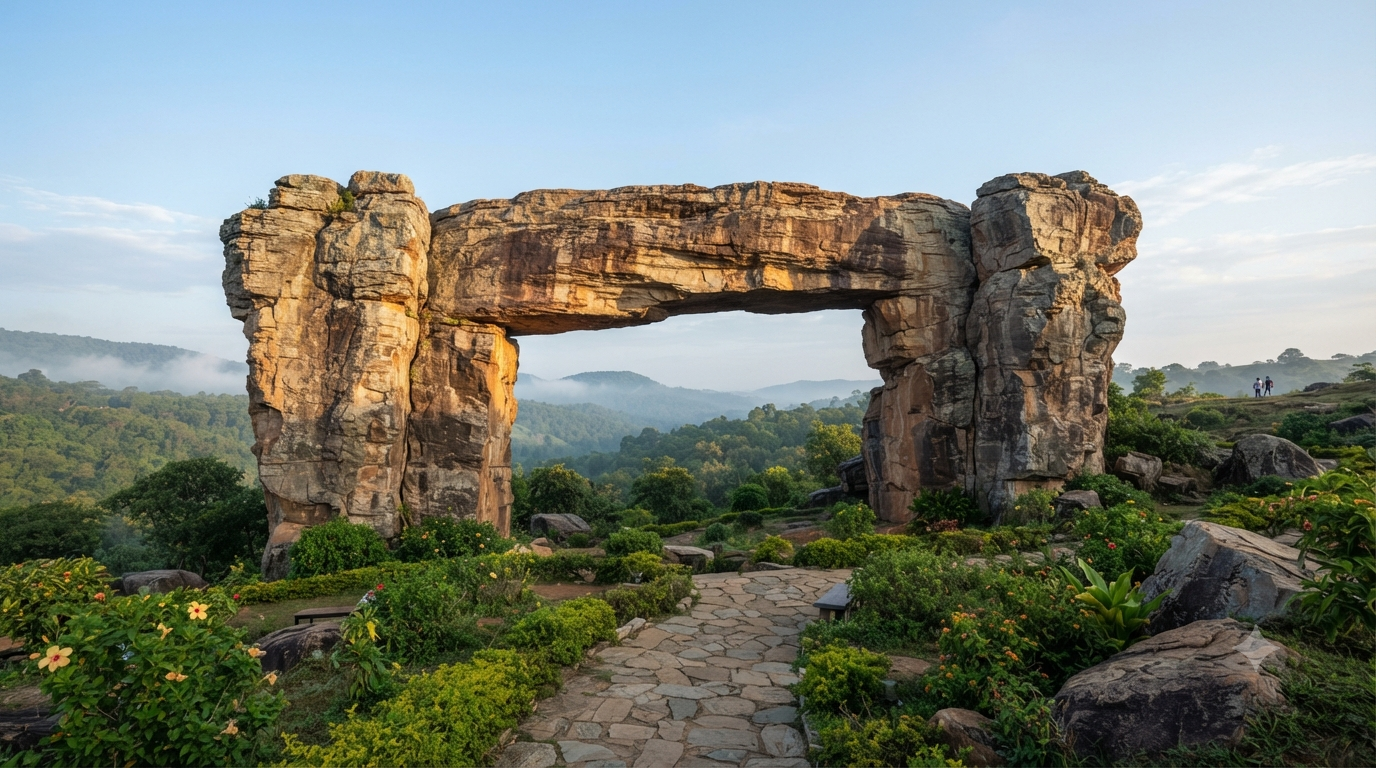
Silathoranam is a natural stone arch in the Tirumala Hills of Andhra Pradesh. It was formed entirely by erosion over millions of years. The name joins two Telugu words. “Sila” means rock, while “thoranam” means a garland or arch strung between two columns.
In plain terms, it looks like a curved rock bridge between two pillars. Nothing props up the connecting span. Because its shape echoes a serpent’s hood, a conch, and a discus, many devotees link it to Lord Vishnu. The site carries scientific weight as well as devotional meaning.
History, Geology And Why The Arch Is So Rare
Geologists documented this formation in the early 1980s while surveying the Tirumala hills. What they found was unusual. Two dissimilar rock masses were joined by a slender natural link, with no human hand involved.
The arch is carved from quartzite of the Cuddapah Supergroup, and that rock dates to the Middle-to-Upper Proterozoic era. Over an immense span of time, wind, water, and stream action wore away the softer rock. Meanwhile, the harder band survived as the arch you see today.
Most sources estimate its age at around 1.5 billion years, although a few cite figures beyond that. Either way, the arch predates almost every landmark a pilgrim knows, since it took shape long before human history began.
The Geological Survey of India recognises the arch as a National Geo-heritage Monument. Moreover, the wider area is known for the Eparchaean Unconformity. That is a vast gap in the rock record, where much younger layers sit directly on ancient basement rock.
Such deep-time context is exactly why the site draws earth-science students alongside pilgrims. It also sits within the Seshachalam Biosphere Reserve, since these hills are protected forest. For the geological record, you can read more on the Natural Arch, Tirumala hills entry.
Tirumala Silathoranam Timings Routes: Visiting Hours
The arch stands in an open, TTD-maintained garden. So there is no darshan-style queue or ticket counter like the main temple. It is generally accessible through daylight hours, and the calmest views come early. Published hours vary between sources, which is where the online confusion begins.
Some listings quote roughly 6 AM to 6 PM, while others give a narrower 9 AM to 5 PM window. A few also note seasonal or maintenance closures. Because no single timing is universally posted, treat these figures as approximate.
So do check the current Tirumala Silathoranam Timings Routes locally on the day you plan to go. This matters most in the monsoon, when heavy rain can shut the path. When in doubt, ask at the temple enquiry counter before you set off.
Tirumala Silathoranam Timings Routes: Best Times To Visit
Early light does this place a real favour. Soft morning sun rakes across the stone and lifts the arch into three dimensions. Midday glare, by contrast, flattens it. Sunset works well too, when the rock glows warm against the sky.
| Time Window | Why It Works |
|---|---|
| 6 AM – 8 AM | Soft light, long shadows, cool air, thin crowds. |
| 9 AM – 11 AM | Brighter, clearer views once any fog lifts. |
| 4 PM – 6 PM | Golden-hour warmth and comfortable temperatures. |
Fog is common on winter mornings. So if the arch is hidden, wait a little in the garden and it usually clears.
How Long Should You Spend?
For photos and a quiet look around, 45 minutes to an hour is enough. If you add Chakra Teertham or simply sit in the garden, budget closer to two hours. Families with children often linger longer, since the open space suits a slower pace.
Entry Fee And Who Manages The Site
Here is the honest answer to a question online guides often get wrong. Reports on the entry fee actually disagree. While several sources say entry is free, others mention a small nominal ticket, or a separate camera and parking charge.
Because no consistent official figure is published, do not rely on any fixed number you read online. Instead, confirm the current fee at the entrance on the day you visit. That way, you avoid both surprise charges and the wrong assumption that you can prepay anywhere.
The arch itself is a National Geo-heritage Monument under the Geological Survey of India. The surrounding Rock Garden and pathways, meanwhile, are developed and maintained by TTD as part of Tirumala. That is why you find clean paths, seating, and a landscaped garden here, rather than a raw trekking site.
How To Reach: Tirumala Silathoranam Timings Routes And Access
Once you are up in Tirumala town, the Tirumala Silathoranam Timings Routes to the arch are short and simple. It lies roughly 1 to 2 km north of the Sri Venkateswara Swamy Temple. The Sri Venkateswara Museum and Chakra Teertham sit close by. From there it is a short, well-marked approach.
Tirumala Silathoranam Timings Routes From The Temple
- On foot: a gentle walk of about a kilometre from the temple area, pleasant if you want the greenery.
- Free TTD town buses: TTD runs free local buses within Tirumala. You can get down near the museum and walk the last stretch.
- Auto or taxi: shared autos and taxis run from near the temple and parking zones. These help if walking is hard for elders in your group.
Drop-off and parking near the museum make the final walk short. Whichever option you pick, the Tirumala Silathoranam Timings Routes from the temple take only a few minutes. Because the arch sits near Srivari Padalu, the highest point on Narayanagiri, many visitors club these spots together.
Reaching Tirumala On Foot: Alipiri And Srivari Mettu
If you climb to Tirumala on foot first, two stepped footpaths bring you up. Both are covered for much of the way. Each also earns you a Divya Darshan token at the top.
- Alipiri Mettu: the traditional route from Alipiri in Tirupati, with about 3,550 steps over roughly 9 km. Plan 3 to 5 hours at a steady pace.
- Srivari Mettu: the shorter, steeper path from Srinivasa Mangapuram. It has about 2,388 steps across 2.1 km, usually walked in 1.5 to 2 hours.
Note that these paths lead to Tirumala, not straight to Silathoranam. After you reach the top and finish darshan, the arch is a short hop north.
What First-Time Visitors Often Get Wrong
A few small habits make the visit smoother. Most of them come down to timing and footwear.
- Start early. Between 6 AM and 8 AM you dodge both the heat and the harshest light.
- Wear grippy shoes. The ground near the arch is uneven, and the rocks turn slick after rain.
- Carry water. Even a short walk feels longer under the Tirumala sun, so stay hydrated.
- Pair it with Chakra Teertham. This sacred pond sits close by and rounds out the trip.
- Respect the site. Many treat the arch as sacred, so avoid loud noise and litter.
A quick safety note. The walk and the footpath climbs are demanding for anyone elderly, pregnant, or managing a heart or joint condition. Pace yourself and rest often. Check with a doctor before a long stepped climb if you are at risk.
Nearby Places Worth Combining
The arch pairs naturally with several spots in the same corner of Tirumala. So you rarely need to plan them as separate trips.
- Chakra Teertham: a sacred pond linked with cleansing rituals, within an easy walk.
- Srivari Padalu: the footprints of the Lord at the highest point of Narayanagiri, close to the arch.
- Sri Venkateswara Museum: a quick cultural stop right beside the access point.
- Papavinasam and Japali Anjaneya Temple: a short drive away for those with extra time.
For planning the wider trip, our Tirumala Tirupati complete guide and darshan ticket procedure cover the temple side in detail.
Before You Go: Tirumala Silathoranam Timings Routes Recap
Silathoranam rewards an unhurried, early visit far more than a mid-afternoon dash. So come soon after sunrise, wear proper shoes, and carry water. Give yourself an hour or two, because ten rushed minutes never do it justice.
When you plan your Tirumala Silathoranam Timings Routes around the morning, you can then pair the arch with Chakra Teertham and the museum. As a result, this billion-year-old wonder becomes one of the quietest highlights of a Tirumala pilgrimage. Since a few details like hours and fees shift, confirm them locally and enjoy the calm most of the crowd tends to miss.
If you are also sorting out logistics up the hill, our guides to the TTD baggage and mobile lockers and food in Tirumala save time once you are up there.
Frequently Asked Questions
What Are The Official Tirumala Silathoranam Timings Routes?
There is no single officially posted timing. Sources vary from roughly 6 AM to 6 PM to a narrower 9 AM to 5 PM. The arch is generally open through daylight hours, with early morning best for light and cool air. Confirm current hours locally, because monsoon rain can close the path.
Is There An Entry Fee For Silathoranam?
Reports differ. Some visitors say entry is free. Others mention a small nominal ticket, or a separate camera and parking charge. Since no fixed figure is consistently published, check the current fee at the gate on the day you visit.
How Far Is Silathoranam From The Main Temple?
The arch is about 1 to 2 km north of the Sri Venkateswara Swamy Temple. It sits near the museum and Chakra Teertham. You can walk it in around 15 to 20 minutes, or take a free TTD town bus, auto, or taxi.
Can You Visit Silathoranam At Night?
No. Access is meant for daylight hours only. After sunset the path is unlit, and the rocky ground is unsafe. So plan to be done by early evening.
Is Silathoranam Worth Visiting With Kids?
Yes. Families visit regularly, and children enjoy the open garden. Just keep little ones close, since the terrain is uneven and the rocks can be slippery when wet.
How Was The Natural Arch Formed?
It formed through natural weathering and erosion over roughly 1.5 billion years. Wind, water, and stream action slowly wore away softer rock in the Cuddapah quartzites. The harder band survived as the arch, with no human construction involved.
What Else Can I See Near Silathoranam?
Chakra Teertham, Srivari Padalu, and the Sri Venkateswara Museum are all within easy reach. With extra time, Papavinasam and Japali Anjaneya Temple are a short drive away. So you can combine several stops in one outing.
Are The Tirumala Silathoranam Timings Routes Different In The Monsoon?
They can be. Heavy rain sometimes closes the arch and the nearby path for safety. During the monsoon, check locally before you set out, and avoid the slippery rocks around the arch.