📖 12 min read · 2,261 words
Sankashti Chaturthi dates in 2026 follow a very different pattern from the old 2022 calendar on this page, so the historical table should no longer be used for current observance. For Telugu families in Andhra Pradesh and Telangana, the next Sankashti after 26 September 2026 is Vighnaraja Sankashti on Tuesday, 29 September. In Hyderabad, Drik Panchang places moonrise at about 8:00 PM that night.
Prayanamam is an independent pilgrimage and festival guide. We are not affiliated with any temple, trust, or panchang publisher, and we do not accept puja bookings, donations, or payments. Sankashti fasting depends on the local moonrise, so always select your own city before using a moonrise time.
Sankashti Chaturthi Dates 2026 at a Glance
The 2026 calendar has 13 Sankashti observances rather than the usual 12 because the Hindu lunar calendar includes an Adhika Jyeshtha month. That extra month runs from mid-May to mid-June in the Telugu calendar and adds the special Vibhuvana Sankashti in June. The monthly date sequence is independently supported by Drik Panchang and AstroSage, although one source differs on the June observance because of location-based moonrise rules.
- Next Sankashti from 26 September 2026: Tuesday, 29 September.
- Next observance name: Vighnaraja Sankashti.
- Hyderabad moonrise on 29 September: about 8:00 PM.
- Angarki Sankashti dates in 2026: 6 January, 5 May, and 29 September.
- Extra lunar-month observance: Vibhuvana Sankashti in Adhika Jyeshtha.
- Last Sankashti of 2026: Saturday, 26 December.
Current Sankashti Chaturthi Dates and Timings for 2026
These Sankashti Chaturthi dates use Hyderabad as the Telugu-region reference for moonrise because the article serves readers in Andhra Pradesh and Telangana. Tithi start and end times are given in Indian Standard Time. Moonrise changes by city, so a Tirupati, Vijayawada, Visakhapatnam, or Warangal reader should recheck the moonrise even when the date stays the same.
2026 Hyderabad Reference Calendar
This table keeps the Sankashti Chaturthi dates, tithi window, and Hyderabad moonrise together so readers do not accidentally combine timings from different cities.
| Date | Sankashti name | Chaturthi tithi | Hyderabad moonrise |
|---|---|---|---|
| 6 January, Tuesday | Lambodara / Sakat Chauth | 6 Jan 08:01 to 7 Jan 06:52 | 9:06 PM |
| 5 February, Thursday | Dwijapriya | 5 Feb 00:09 to 6 Feb 00:22 | 9:30 PM |
| 6 March, Friday | Bhalachandra | 6 Mar 17:53 to 7 Mar 19:17 | 9:00 PM |
| 5 April, Sunday | Vikata | 5 Apr 11:59 to 6 Apr 14:10 | 9:27 PM |
| 5 May, Tuesday | Ekadanta / Angarki | 5 May 05:24 to 6 May 07:51 | 9:59 PM |
| 3 June, Wednesday | Vibhuvana | 3 Jun 21:21 to 4 Jun 23:30 | 9:32 PM |
| 3 July, Friday | Krishnapingala | 3 Jul 11:20 to 4 Jul 12:39 | 9:33 PM |
| 2 August, Sunday | Gajanana | 1 Aug 23:07 to 2 Aug 23:15 | 9:20 PM |
| 31 August, Monday | Heramba | 31 Aug 08:50 to 1 Sep 07:41 | 8:35 PM |
| 29 September, Tuesday | Vighnaraja / Angarki | 29 Sep 17:09 to 30 Sep 14:55 | 8:00 PM |
| 29 October, Thursday | Vakratunda | 29 Oct 01:06 to 29 Oct 22:09 | 8:41 PM |
| 27 November, Friday | Ganadhipa | 27 Nov 09:48 to 28 Nov 06:39 | 8:39 PM |
| 26 December, Saturday | Akhuratha | 26 Dec 20:04 to 27 Dec 17:12 | 8:32 PM |
How to Use the Hyderabad Timings
Drik Panchang provides the Hyderabad-specific date and moonrise calculations used above. AstroSage independently confirms the same 2026 date sequence, including the three Tuesday Angarki dates. For another city, use the location selector on Drik Panchang rather than copying Hyderabad moonrise times.
What Is the Next Sankashti Chaturthi in 2026?
The next observance is Tuesday, 29 September 2026, which is Vighnaraja Sankashti and also Angarki Sankashti because it falls on a Tuesday. In Hyderabad, Chaturthi begins at 5:09 PM on 29 September and ends at 2:55 PM on 30 September. Moonrise is listed at about 8:00 PM.
This timing is especially useful because the tithi begins only a few hours before the moon rises. Therefore, the evening moonrise falls well inside Chaturthi in Hyderabad. A different city may show moonrise several minutes earlier or later, so use a city-specific panchang if you are completing a vrat.
Why 2026 Has 13 Sankashti Observances
Most Gregorian years show 12 monthly Sankashti observances, but 2026 has an extra lunar month. The Telugu lunar calendar inserts Adhika Jyeshtha from 17 May to 15 June. Drik Panchang lists Vibhuvana Sankashti during that extra month on 3 June for Hyderabad.
This is exactly why carrying a 2022, 2025, or any previous-year festival table forward can fail. The lunar calendar does not move by a fixed number of days each year. When Adhika Masam appears, later lunar months and festivals can shift by several weeks compared with the previous year.
Prayanamam’s current Karthika Pournami 2026 guide shows the same effect later in the year. Its date moves deep into November because of the extra lunar month. The site’s Ayudha Puja 2026 guide also uses current panchang data instead of preserving the old 2022 calendar.
Why Some Sites Show June 3 and Others June 4
This is the one 2026 date where readers can encounter a real source disagreement. Drik Panchang’s Hyderabad page lists Vibhuvana Sankashti on Wednesday, 3 June, and AstroSage also lists 3 June in its 2026 annual calendar. Prokerala’s annual Sankashti page, however, labels the observance as 4 June while showing the same Chaturthi tithi beginning on the night of 3 June.
The difference comes from how the moonrise rule is applied for a chosen location. Sankashti is observed when Chaturthi prevails at local moonrise, not simply when the tithi begins. For Telugu readers using Hyderabad as the reference city, this page follows the Hyderabad-specific Drik calculation and therefore uses 3 June.
If your family follows a different city, temple calendar, or panchang tradition, use that system consistently. Do not mix one source’s date with another source’s moonrise time. That is the easiest way to create a one-day error.
How Sankashti Chaturthi Dates Are Chosen
Sankashti Chaturthi dates are based on Krishna Paksha Chaturthi, the fourth lunar tithi after Purnima. However, the fasting date is not decided from the Gregorian date on which Chaturthi begins. The key rule is whether Chaturthi is prevailing at the local moonrise.
That makes Sankashti different from a simple midnight-to-midnight festival date. Two nearby cities can occasionally produce different observance days because moonrise changes with longitude and latitude. Drik Panchang specifically warns that location-based Sankashti dates can differ even within the same state.
For practical use, check three things: the local observance date, the Chaturthi start and end times, and the moonrise for your city. If all three come from the same panchang setting, the risk of mixing incompatible timings is much lower.
Sankashti Chaturthi Dates for the Rest of 2026
As of 26 September 2026, four Sankashti Chaturthi dates remain in the calendar year. These are the dates readers planning a current vrat actually need now.
- 29 September: Vighnaraja Sankashti, Tuesday, and therefore Angarki Sankashti.
- 29 October: Vakratunda Sankashti, Thursday.
- 27 November: Ganadhipa Sankashti, Friday.
- 26 December: Akhuratha Sankashti, Saturday.
For Hyderabad, the listed moonrise times are about 8:00 PM, 8:41 PM, 8:39 PM, and 8:32 PM respectively. Those clock times should not be copied to another city without checking. The observance sequence is current for 2026, while the method for checking your local moonrise remains evergreen.
What Does Sankashti Chaturthi Mean in Telugu Tradition?
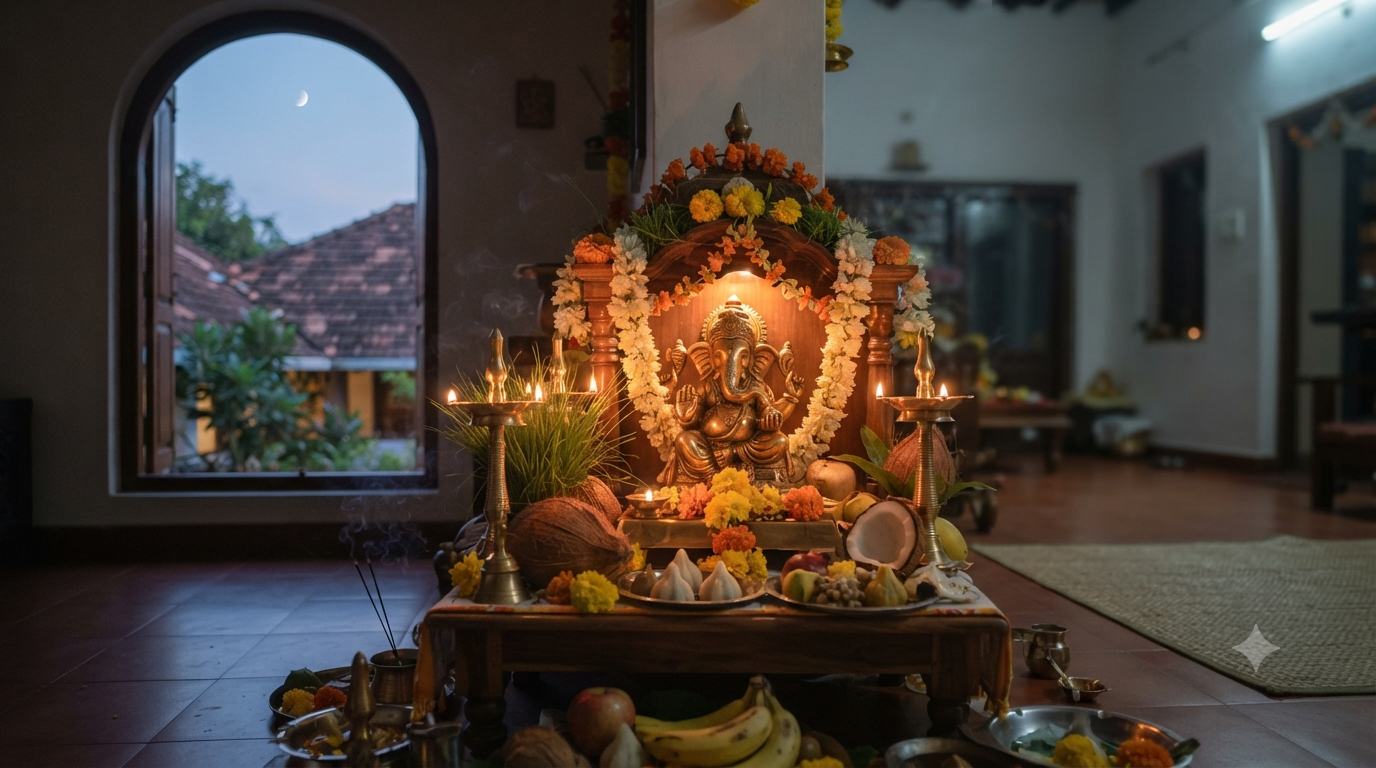
Sankashti Chaturthi is commonly called Sankatahara Chaturthi or Sankashtahara Chavithi in Telugu-speaking families. It is a monthly Ganesha vrat observed during Krishna Paksha. Devotees traditionally pray for the removal of obstacles and for clarity, peace, and family well-being.
Those outcomes belong to religious belief and devotional tradition, not to guaranteed results. Customs also differ between households. Some families keep a strict fast until moonrise, while others take fruit, milk, or simple vrat foods during the day.
Many devotees perform the main Ganesha puja in the evening before moonrise. After the moon becomes visible, they offer arghya to Chandra and then complete the vrat. A local priest or family tradition can guide any household-specific mantra or vrata katha.
Sankashti Chaturthi Telugu Puja Procedure
The home procedure can stay simple because devotion matters more than an elaborate setup. If your family already follows a specific paddhati, keep that practice. The sequence below is a general Telugu household outline.
- Clean the puja area. Bathe, wear clean clothes, and place a Ganesha image or murti in the worship space.
- Take the sankalpam. State that you are observing Sankatahara Chaturthi according to your family tradition.
- Light a lamp and incense. Offer flowers, durva grass where available, fruit, coconut, and a simple naivedyam.
- Chant a Ganesha mantra. “Om Gam Ganapataye Namah” is widely used. A fixed count is optional unless your tradition specifies one.
- Read or hear the vrat katha. Families may use the monthly Sankashti katha associated with that Ganapati form.
- Check the local moonrise. Do not rely on a national time because moonrise is location-specific.
- Offer arghya to the moon. After moonrise, complete the prayer and break the fast according to your custom.
What offerings are commonly used?
Common offerings include modakam, undrallu, fruit, coconut, jaggery preparations, flowers, and durva grass. The exact naivedyam varies by region and household. A simple vegetarian offering is sufficient if you do not follow a detailed family procedure.
Avoid presenting a particular food, mantra count, or ritual step as compulsory for everyone. Sankashti practice differs between Telugu, Marathi, Kannada, and Tamil traditions. Family custom should take priority where it has been followed consistently.
What Is Angarki Sankashti in 2026?
When Sankashti Chaturthi falls on a Tuesday, it is called Angarki or Angaraki Sankashti. In 2026, the Tuesday observances fall on 6 January, 5 May, and 29 September. AstroSage also marks those three dates as Angarki Chaturthi in its annual 2026 list.
Many devotees consider an Angarki observance especially significant within Ganesha worship. That importance is devotional rather than scientific. The fasting and moonrise rules remain the same, so the local panchang still controls the practical date and completion time.
Fasting Rules and Health Safety
A strict Sankashti fast can run from morning until late evening, and summer moonrise may come close to 10 PM. Anyone with diabetes, kidney disease, low blood pressure, pregnancy, or a medication schedule should speak with a qualified doctor before attempting a strict fast.
Many families allow fruit, milk, nuts, or vrat foods when a full fast is not suitable. Do not stop prescribed medicines for a ritual fast unless your clinician has told you to do so. Religious observance is a matter of faith and should not replace medical care.
Children, older adults, and people working in heat may also need a lighter observance. A partial fast, simple puja, and prayer can preserve the devotional purpose without creating avoidable health risk.
Sankashti Chaturthi vs Vinayaka Chaturthi
Sankashti Chaturthi falls during Krishna Paksha after the full moon. Monthly Vinayaka Chaturthi falls during Shukla Paksha after Amavasya. The large annual Ganesh Chaturthi festival is the Bhadrapada Shukla Chaturthi observance, so it is not the same as the monthly Sankashti vrat.
This distinction matters because a search for “Chaturthi” can return both calendars. If you are fasting until moonrise, you are looking for Sankashti or Sankatahara Chaturthi. If you are checking the monthly daytime Ganesha Chaturthi after Amavasya, that is a different observance.
How to Check Sankashti Chaturthi Dates Every Year
The safest evergreen method is to avoid copying any annual table into the next year. Instead, open a panchang that supports location selection, choose your city, select the required year, and confirm the Krishna Paksha Chaturthi that prevails at moonrise.
Use at least two established sources for the annual date sequence when publishing a calendar. Then use one location-specific source for the moonrise column. If sources disagree, do not force a single national date without explaining why the difference exists.
This page uses Drik Panchang for Hyderabad-specific moonrise and tithi calculations, while AstroSage provides an independent check on the 2026 date sequence.
Before You Observe the Next Sankashti
The main current date to remember is Tuesday, 29 September 2026. It is Vighnaraja Sankashti and also Angarki Sankashti. In Hyderabad, Chaturthi begins at 5:09 PM, moonrise is around 8:00 PM, and the tithi ends the following afternoon.
The Sankashti Chaturthi dates are reliable planning anchors, but always recheck moonrise for your own city on the day. That single step is more reliable than copying a generic “pooja time” from an old article. It also keeps this guide useful even when the yearly calendar changes.
Frequently Asked Questions
What are the next Sankashti Chaturthi dates in 2026?
The remaining Sankashti Chaturthi dates in 2026 are 29 September, 29 October, 27 November, and 26 December. The 29 September observance is Vighnaraja Sankashti and falls on a Tuesday, so it is also Angarki Sankashti.
What time is Sankashti moonrise on 29 September 2026?
Drik Panchang lists Hyderabad moonrise at about 8:00 PM on 29 September 2026. Another calculator may differ by a few minutes because coordinates and astronomical methods vary. Use the moonrise for your exact city rather than copying Hyderabad time across India.
Why are there 13 Sankashti dates in 2026?
There are 13 observances because 2026 includes an Adhika Jyeshtha lunar month. The extra month creates an additional Sankashti called Vibhuvana Sankashti. For Hyderabad, Drik Panchang places that observance on 3 June 2026.
Is Sankashti on 3 June or 4 June 2026?
For Hyderabad, this guide uses 3 June because Drik Panchang’s city-specific calculation and AstroSage’s annual list both support that date. Prokerala labels it 4 June on its general annual page, which shows why location and moonrise rules must be checked instead of mixing calendars.
Which 2026 Sankashti dates are Angarki?
The Tuesday Sankashti observances in 2026 fall on 6 January, 5 May, and 29 September. These are commonly called Angarki or Angaraki Sankashti. The September observance is the next Angarki date from the current 26 September reference point.
Can I use one moonrise time for all of Andhra Pradesh and Telangana?
No. Moonrise varies by city, so Hyderabad, Tirupati, Vijayawada, and Visakhapatnam can show different clock times. The tithi window may be the same, but the fasting completion time should come from your own location.
Can I eat during Sankashti fasting?
Practice varies by family. Some devotees keep a strict fast, while others use fruit, milk, nuts, or vrat foods until moonrise. If fasting affects a medical condition or prescribed medicine, follow professional medical advice rather than forcing a strict fast.
Is Sankashti Chaturthi the same as Ganesh Chaturthi?
No. Sankashti falls on Krishna Paksha Chaturthi after Purnima, while monthly Vinayaka Chaturthi falls on Shukla Paksha Chaturthi after Amavasya. The major annual Ganesh Chaturthi festival is also a Shukla Paksha observance.